
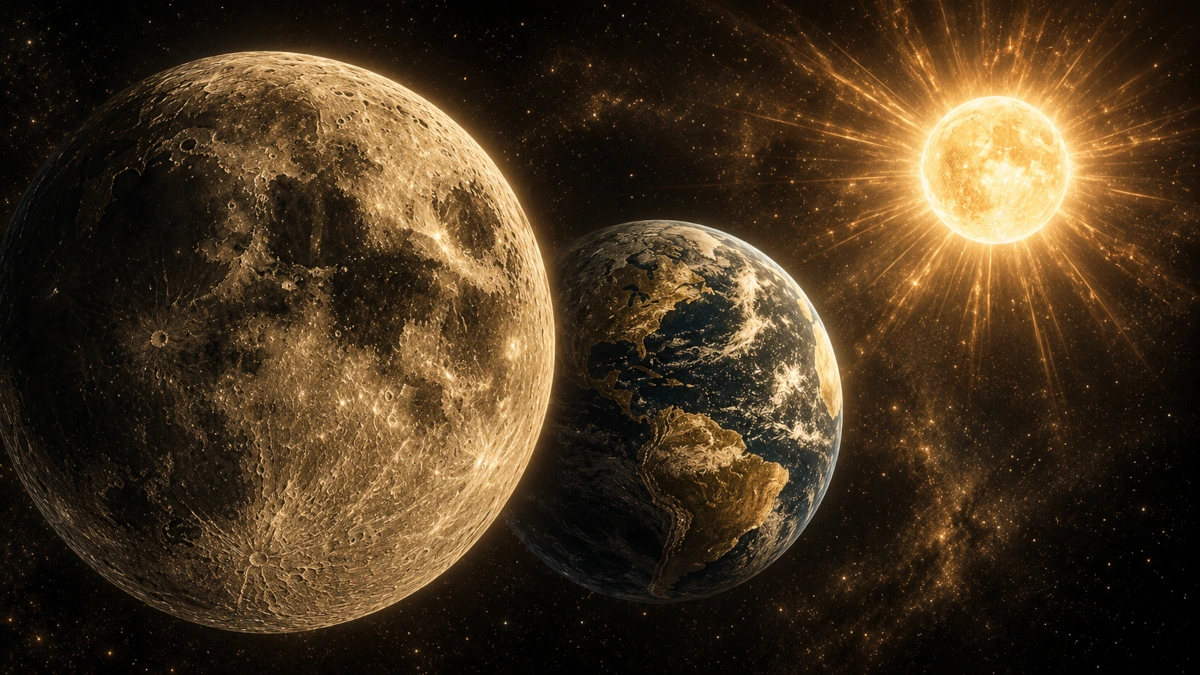
Living Rhythms – From Cosmic Forces to the Resonant Dance of Life
An exploration of the silent forces shaping life—through tides, light, fluctuation, and resonance, inspired by the vision of SynchronSpirit.
Living Rhythms: Moon, Sun, and the Fluctuation of Being
When we examine the relationship between the environment and biological systems, a fascinating principle emerges: life responds to the forces of nature in ways that require neither conscious intelligence nor deliberate planning.
Across countless generations, organisms have developed structures and processes attuned to the recurring rhythms of their surroundings. Light and darkness, temperature fluctuations, gravitational cycles, and seasonal changes form a complex environment in which life continuously adapts.
These relationships suggest a profound connection between living systems and the rhythms of the natural world—a connection that SynchronSpirit explores through the concept of resonance.
But how far does this relationship extend? And where does measurable biological adaptation give way to questions of perception, meaning, and consciousness?
Tidal Forces as Silent Impulses
The gravitational influence of the Moon on Earth is well established, most visibly expressed in the rise and fall of ocean tides.
Less apparent are the subtle gravitational variations that extend throughout the Earth and its living systems.
Lunar tidal forces act on matter across the planet, although their direct mechanical effects at the level of individual cells are extraordinarily small. Whether such subtle influences have any biological significance remains an open question requiring careful investigation.
Nevertheless, the relationship between tidal rhythms and life is not merely hypothetical.
Many marine organisms exhibit biological rhythms associated with tidal cycles. Their feeding, reproduction, and activity patterns may follow the periodic movements of the oceans.
These observations reveal an important distinction: biological systems may respond to the environmental consequences of gravitational forces without necessarily detecting those forces directly.
For SynchronSpirit, this distinction opens an intriguing field of inquiry.
The question is not simply whether cosmic forces act upon living organisms, but how physical influences become biological rhythms—and how those rhythms may eventually enter the realm of experience.
Cyclical Imprinting and Anticipation
Because many environmental rhythms recur with remarkable regularity, organisms can develop mechanisms that anticipate predictable changes.
Biological clocks provide a familiar example.
Circadian rhythms regulate numerous physiological processes in relation to the approximately twenty-four-hour cycle of day and night. Other organisms exhibit rhythms associated with lunar, tidal, or seasonal cycles.
These mechanisms allow life to prepare for environmental changes before they occur.
Such anticipation does not require conscious foresight. It emerges through biological regulation, evolutionary adaptation, and the interaction between internal timing systems and external signals.
What appears to be a silent form of foreknowledge is therefore, in many cases, an expression of biological organization.
Yet this capacity remains remarkable.
Life does not merely react to the present. It carries within its structures a relationship to recurring patterns of the future.
Within the perspective of SynchronSpirit, this suggests a broader philosophical question: can resonance be understood not only as a response to external conditions, but also as a form of temporal attunement?
Primary, Secondary, and Tertiary Effects
The influence of the Moon and Sun on life is not limited to direct interactions with biological systems.
Their effects unfold through multiple layers of the Earth’s physical environment.
To examine these relationships, SynchronSpirit proposes a conceptual distinction between primary, secondary, and tertiary effects.
Primary effects arise from the direct physical influence of solar radiation and gravitational forces on the Earth.
Solar energy drives atmospheric circulation, influences temperature, powers evaporation, and sustains the processes underlying the global water cycle.
The gravitational attraction of the Moon and Sun generates tides and contributes to the dynamic behaviour of the Earth’s oceans and solid structure. The Moon’s gravitational influence also plays an important role in stabilizing the Earth’s axial tilt over long timescales.
Secondary effects emerge as these physical processes shape environmental conditions.
Ocean currents, coastal habitats, climate patterns, seasonal variations, and the distribution of available energy all form part of the changing circumstances in which life develops.
Tertiary effects become visible within biological systems themselves.
Plants respond to light and seasonal changes. Marine organisms synchronize aspects of their behaviour with tidal cycles. Animals adjust migration, reproduction, and activity patterns to recurring environmental conditions.
Human beings, too, are influenced by environmental rhythms, particularly through the effects of light on sleep, hormonal regulation, and circadian timing.
These three levels are not intended as a fixed scientific classification, but as an analytical framework for tracing the pathways through which physical forces may influence living systems.
They illustrate how a relatively simple external rhythm can become part of an intricate network of biological responses.
And they invite a further question: when does a physical rhythm become a perceived rhythm—and when does perception begin to assign meaning to it?
Collective Fields and Social Resonance
Living organisms do not experience their environment in complete isolation.
Shared environmental rhythms can synchronize biological processes across individuals and populations.
The alternation of day and night provides a particularly clear example. Light acts as a powerful environmental signal, coordinating biological timing across many species.
Seasonal cycles likewise influence collective patterns of activity, reproduction, migration, and social behaviour.
In certain marine ecosystems, lunar and tidal rhythms contribute to the synchronization of biological events.
These phenomena demonstrate that collective biological coordination can emerge without conscious communication between organisms.
However, the possibility that extremely weak direct tidal forces generate shared emotional or mental states in human populations remains speculative. There is currently no established evidence that such forces explain collective moods, rituals, or cultural behaviour.
Nevertheless, the broader relationship between environmental rhythms and collective human experience deserves consideration.
Human societies organize themselves around recurring cycles: days and nights, seasons, agricultural periods, religious calendars, and shared cultural practices.
These rhythms shape expectations, behaviour, and social coordination.
From the perspective of SynchronSpirit, collective resonance may therefore be explored as a relationship between shared environmental conditions, biological timing, cultural structures, and subjective experience.
Rather than assuming an invisible force connecting minds, this approach begins with observable patterns and asks how shared rhythms contribute to the emergence of collective meaning.
The Role of the Sun
Alongside the Moon, the Sun exerts a gravitational influence on Earth and contributes significantly to the generation of tides.
Yet its most profound influence on life comes through radiation.
Solar energy drives photosynthesis, sustains food webs, influences the Earth’s climate, and regulates biological rhythms through the alternation of light and darkness.
Without the continuous flow of solar energy, the overwhelming majority of Earth’s ecosystems could not exist in their present form.
The Moon, meanwhile, contributes to tidal cycles and influences the timing of certain biological processes, particularly in marine environments.
In this sense, the Sun may be regarded as a principal source of life’s energy, while the Moon serves as one of the natural timekeepers of earthly rhythms.
This distinction is both physical and symbolic.
One provides the energy upon which most life depends. The other contributes to recurring patterns through which parts of life organize themselves.
Together, they illustrate how living systems are embedded within a larger astronomical environment.
The Implicit Intelligence of Nature
Biological systems often display an extraordinary capacity to adapt, regulate, and coordinate their activities.
Yet this apparent intelligence does not necessarily imply conscious awareness or deliberate intention.
Evolution, natural selection, self-organization, and physiological regulation can produce highly sophisticated relationships between organisms and their surroundings.
A plant turns towards light without understanding the Sun. A marine organism may anticipate a tidal cycle without consciously calculating gravitational forces.
What appears to be wisdom can emerge through the accumulated history of adaptation.
Within SynchronSpirit, the expression implicit intelligence of nature is used as a philosophical metaphor for this remarkable organization.
It describes the capacity of living systems to embody relationships with their environment without requiring conscious knowledge of the processes involved.
This perspective does not replace biological explanations. Rather, it invites us to consider their broader significance.
Life is not separate from the forces that shape it.
Its structures carry the history of those forces, and its rhythms reveal the continuing relationship between organism and world.
SynchronSpirit: Resonance as a Model of Understanding
SynchronSpirit approaches life not as an isolated phenomenon, but as an integral part of a network of physical interactions, biological adaptations, and meaningful experiences.
Within this framework, resonance can be considered on several levels.
At the physical level, resonance describes specific interactions between oscillating systems.
At the biological level, rhythmic coordination and synchronization may emerge through physiological mechanisms and environmental signals.
At the psychological and symbolic level, resonance describes the experience of meaningful correspondence between inner states and external events.
These forms of resonance should not be treated as scientifically identical.
Their relationship is an object of philosophical reflection and potential interdisciplinary investigation, rather than an established unified mechanism.
Yet considering them together may offer a productive way to explore how patterns move between different levels of reality.
From planetary cycles to cellular regulation, from biological timing to conscious interpretation, the natural world reveals an intricate interplay of structure and change.
SynchronSpirit seeks to investigate these relationships while remaining attentive to the distinction between observable phenomena, theoretical models, and subjective meaning.
The aim is not to reject mechanistic explanations, but to ask whether understanding the mechanisms of life fully exhausts the significance of living experience.
Perception, Fluctuation, and the Question of Reality
The rhythms that shape biological life are not always directly accessible to conscious perception.
Many processes occur beneath the threshold of awareness, while others become visible only through scientific instruments and systematic observation.
This reminds us that human perception offers a limited, though indispensable, perspective on the world.
Modern physics has also transformed our understanding of observation.
At the quantum level, measurement involves physical interaction rather than mere passive observation. Such interactions can affect the systems being measured.
However, this does not establish that human consciousness creates physical reality, nor does it demonstrate a direct connection between quantum measurement and subjective perception.
Whether quantum theory offers meaningful philosophical parallels to the relationship between observer and world remains a matter of interpretation and debate.
For SynchronSpirit, the deeper question is therefore not whether consciousness determines the physical universe, but how our experience of reality emerges through the interaction of perception, interpretation, and an independently existing environment.
Reality may be described through physical processes, yet our understanding of it is always shaped by the ways in which we observe, organize, and interpret those processes.
Meaning emerges within this relationship.
A rhythm can be measured as a recurring physical event. It can also be experienced as anticipation, memory, harmony, or disruption.
These perspectives need not contradict one another.
They illuminate different dimensions of the same encounter between life and world.
From this perspective, SynchronSpirit explores the possibility that resonance may serve as a conceptual bridge between natural processes and meaningful experience—not as a proven universal force, but as a framework for inquiry.
Life is embedded in cosmic rhythms.
And through perception, memory, and interpretation, it participates in transforming those rhythms into lived experience.
Perhaps the most compelling mystery is not that the universe speaks to us, but that life has developed the capacity to experience its patterns as meaningful.
Reflection Questions for Readers
How do you experience the subtle rhythms that flow through your world?
Which of these rhythms can you observe directly, and which become meaningful through your interpretation?
And what might it mean to consciously recognize the relationship between the forces that shape life and the meanings we discover within it?
🌙 From Alarik's Field of Resonance — All Rights Reserved
This article is part of the SynchronSpirit book project and was originally published on Substack on April 26, 2025.
This revised English edition has been prepared for publication on AlarikTarot.com.
All content is protected by copyright. Quotations are welcome with appropriate attribution.
For republication, reproduction, or editorial use, please get in touch through.
This article was originally published on SynchronSpirit (Substack) on April 26, 2025, and has since been revised, scientifically refined, and expanded for AlarikTarot.com.
ALARIK TAROT
TAROT & SYMBOLIC INSIGHT
Beyond the Visible. Into the Meaning.
Personal Tarot & Lenormand Readings, Astrology and Mystical Exploration
Request a Personal Reading
Legal Information
Tarot and astrology readings offer symbolic interpretation and personal reflection. They are not a substitute for professional medical, psychological, legal or financial advice.
© 2026 Alarik Tarot · All rights reserved.