Tarot vs. Lenormand: Two Card Systems, Two Ways of Interpretation
Differences, similarities, and how to decide which system might be right for your question.
At first glance, Tarot and Lenormand appear to have much in common. Both use cards featuring symbolic images. Both are used to explore personal questions, spiritual perspectives, and traditional forms of fortune-telling. And both can offer fresh ways of looking at a person’s circumstances during a reading.
Yet a closer examination reveals two distinct languages.
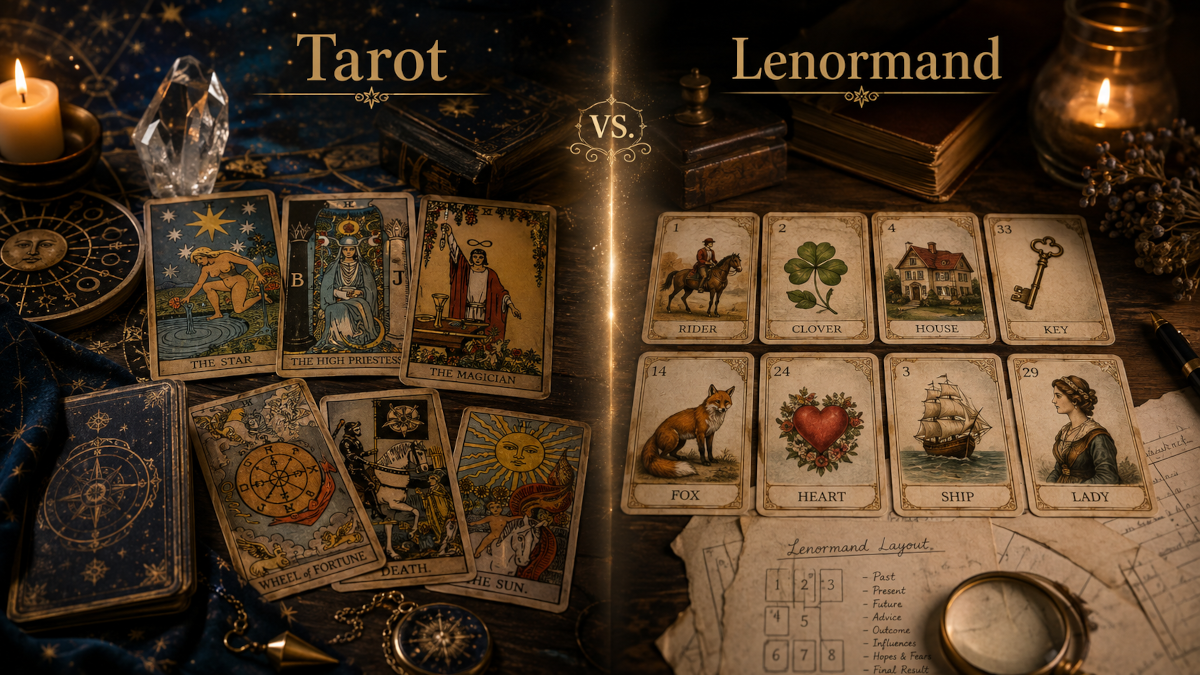
Tarot uses a richly layered visual world in which human experiences, archetypal motifs, and philosophical ideas are interconnected. Lenormand, by contrast, employs a smaller collection of concrete symbols whose meanings emerge particularly through their combinations.
While Tarot often explores what a situation means to an individual, Lenormand traditionally places greater emphasis on the relationships between people, circumstances, and events.
This distinction, however, is not absolute. Both systems can be interpreted in different ways, and neither has a scientifically demonstrated ability to predict future events reliably.
The essential question, therefore, is not which card system reveals the truth more accurately, but which offers the more meaningful framework for interpreting a particular question.
1. Two Different Historical Origins
Tarot: From Renaissance Card Game to Esoteric Symbolic System
The documented history of Tarot begins in fifteenth-century northern Italy.
Card games emerged there that combined the four familiar suits with an additional sequence of illustrated trump cards. These so-called triumph cards originally belonged to a courtly gaming tradition.
It was not until the late eighteenth century that a systematic esoteric interpretation of Tarot developed in France.
Writers such as Antoine Court de Gébelin and Jean-Baptiste Alliette, known as Etteilla, associated the cards with ideas of hidden wisdom and the practice of divination.
During the nineteenth and early twentieth centuries, further correspondences were introduced, particularly from astrology, Kabbalah, and Western esotericism.
With the publication of the Rider-Waite-Smith Tarot in 1909, modern Tarot interpretation acquired a visual language that remains widely influential today.
Tarot therefore has two clearly distinguishable historical traditions: its origins as a card game and its later development as a system of spiritual and symbolic interpretation.
Lenormand: A Card System with a Famous Name
The history of Lenormand is more recent.
The system takes its name from the French fortune-teller Marie-Anne Adélaïde Lenormand (1772–1843), who became well known for her card-reading practice in the early nineteenth century.
However, there is no reliable evidence that she developed the 36-card system commonly used today.
Its principal images can be traced to Das Spiel der Hoffnung (The Game of Hope), published by Johann Kaspar Hechtel in Nuremberg around 1799.
That game already contained the 36 symbols that would later become characteristic of the Petit Lenormand.
It was only after the famous fortune-teller’s death that card decks bearing her name became widespread.
This reveals a notable difference from Tarot. While Tarot developed from a gaming tradition that evolved over several centuries, the Petit Lenormand acquired its present identity through the association of an earlier card game with a later tradition of fortune-telling.
2. The Structure: 78 Cards Versus 36 Symbols
The differences in interpretation begin with the structure of the decks themselves.
Tarot: A System of Major and Minor Arcana
A traditional Tarot deck consists of 78 cards.
Of these, 22 belong to the Major Arcana. They depict figures and motifs such as the Fool, the Magician, the High Priestess, Death, and the World.
In modern symbolic interpretation, these cards are often associated with fundamental human experiences: new beginnings, transformation, responsibility, loss, understanding, and fulfilment.
The remaining 56 cards form the Minor Arcana.
They are divided into four suits: Wands, Cups, Swords, and Pentacles. Each suit contains ten numbered cards and four court cards.
In many contemporary traditions, Wands are associated with activity and willpower, Cups with emotions and relationships, Swords with thought and conflict, and Pentacles with material and practical aspects of life.
These associations are interpretative conventions, not objectively established properties of the cards.
The illustrated numbered cards of the Rider-Waite-Smith Tarot, in particular, offer numerous opportunities to represent human experiences symbolically.
Lenormand: 36 Cards with Concrete Images
The Petit Lenormand consists of 36 cards.
Its images include the Rider, Ship, House, Tree, Clouds, Ring, Heart, and Key.
Unlike Tarot, it is not divided into Major and Minor Arcana.
Each card has a traditional range of meanings, usually more narrowly defined than those of many Tarot cards.
The Ring, for example, may represent commitments, agreements, or recurring obligations. The House is often associated with family, living arrangements, or one’s immediate environment. The Letter traditionally refers to messages, documents, or communication.
However, a Lenormand card is rarely understood fully when considered in isolation.
Its meaning emerges especially through its relationship with other cards.
Tarot often develops its interpretations through the depth of individual images. Lenormand develops them primarily through the relationships between several symbols.
3. The Language of the Cards: Imagery and Combination
Perhaps the most important difference lies not in the number of cards, but in how their meanings are connected.
Tarot: One Image Opens Several Perspectives
Imagine that the Tower appears in a Tarot reading.
In the Rider-Waite-Smith Tarot, we see a structure struck by lightning. Figures fall from a great height as the tower’s crown is thrown aside.
This image can evoke different associations.
Perhaps it suggests the collapse of a long-held belief. Perhaps an unexpected change, or the realization that something once considered secure is no longer stable.
Which interpretation is meaningful depends on the question, the card’s position, and the surrounding cards.
The Tower does not prove that a disaster is approaching. Its symbolism may, however, encourage reflection on stability, vulnerability, and change.
Tarot operates here through an open visual language.
A single card can illuminate different aspects of a situation without necessarily producing one definitive conclusion.
Lenormand: Meaning Emerges Through Connection
Lenormand also contains a card called the Tower.
Yet it depicts a different image and belongs to a different interpretative tradition.
The Lenormand Tower is often associated with institutions, authorities, boundaries, distance, or an elevated position.
When it appears alongside the Letter, the combination might, depending on the question, be interpreted as written communication from an institution.
When the Tower appears next to the Heart, a traditional interpretation might instead explore emotional distance or boundaries within a relationship.
Such combinations are not unambiguous. Their interpretation depends partly on the sequence, placement, and context of the cards.
Nevertheless, the central distinction becomes clear.
While the Tarot Tower often encourages a multilayered symbolic interpretation, the combination of two concrete Lenormand images tends to produce a more situation-specific statement.
The two methods therefore follow different principles of constructing meaning.
4. A Practical Example: The Same Question, Two Approaches
Consider someone asking:
“Should I change jobs?”
The Question Explored Through Tarot
Example cards: The Fool — Two of Wands — Four of Pentacles
The Fool may symbolize a new beginning and the willingness to venture into unfamiliar territory.
The Two of Wands draws attention to planning, possibilities, and choosing between different paths.
The Four of Pentacles might represent a need for financial security or difficulty letting go of familiar circumstances.
Together, these images invite an examination of inner tensions.
How strong is the desire for change? Which possibilities have already been considered? How important is financial security?
The reading does not determine whether changing jobs is the right choice. It provides a symbolic framework for examining one’s own attitude toward the decision.
The Same Question Explored Through Lenormand
Example cards: Crossroads — Fish — Anchor
The Crossroads traditionally represents alternatives and decisions.
The Fish is often associated with money, business matters, or financial resources.
The Anchor may symbolize work, stability, and long-term commitments.
In a Lenormand interpretation, this combination might direct attention toward the financial conditions surrounding a career decision and the desire for stable employment.
Here, the interpretation emerges less from a psychological narrative than from the connection between specific fields of meaning.
Yet these cards cannot predict which employer will ultimately be the better choice.
The actual decision should be based on verifiable information: contractual terms, income, opportunities for advancement, and personal circumstances.
What Does This Comparison Reveal?
Both systems can address the same question.
In this example, Tarot places greater emphasis on examining personal motivations. Lenormand approaches the situation through more concrete themes such as choice, money, and professional stability.
This does not mean that Tarot cannot address practical questions or that Lenormand cannot inspire personal insights.
The difference lies primarily in their respective languages of interpretation.
5. Which Card Spreads Are Used?
The arrangement of the cards also frequently differs.
Tarot readings may use three-card spreads, the Celtic Cross, or individually designed layouts.
Each position is assigned a particular function. One card might symbolize the present situation, another a challenge, and a third a possible direction for action.
In Lenormand, rows, combinations, and spatial relationships play a particularly important role.
One well-known method is the Grand Tableau.
In this layout, all 36 cards are placed on the table. Their positions and relationships form the basis for a more extensive interpretation.
Such a reading can explore different areas of life within one interconnected arrangement.
Smaller spreads using three, five, or nine cards are also common.
The number of cards does not determine the quality of a consultation. What matters is whether the chosen spread suits the question and whether the interpretation is coherent and understandable.
6. Tarot vs. Lenormand: Key Differences at a Glance
| Feature | Tarot | Lenormand |
|---|---|---|
| Historical origins | Northern Italy, 15th century | Imagery from The Game of Hope, around 1799 |
| Standard deck size | 78 cards | 36 cards |
| Structure | Major and Minor Arcana | A single sequence of numbered symbolic cards |
| Visual language | Often allegorical and multilayered | Predominantly concrete and representational |
| Main interpretative focus | Individual images, positions, and symbolic relationships | Card combinations, sequence, and spatial relationships |
| Typical questions | Personal development, inner conflicts, complex decisions | Everyday matters, relationships, career, and practical situations |
| Traditional fortune-telling | Yes | Yes |
| Scientifically established predictive ability | No | No |
These differences describe common interpretative traditions. They are not rigid rules.
An experienced reader can interpret Tarot in highly practical terms and use Lenormand for nuanced personal reflection.
7. Can Tarot and Lenormand Predict the Future?
Historically, both Tarot and Lenormand have been used for fortune-telling.
Their images have been associated with possible developments, events, and decisions.
Part of their enduring fascination comes from this tradition.
However, there is no reliable scientific evidence that either card system can consistently predict future events.
An interpretation that sounds precise is not necessarily an accurate prediction.
Lenormand’s concrete symbolic language, in particular, can create an impression of unusual certainty. When the Ring and Heart appear together, for example, it is easy to formulate a statement about a romantic relationship.
But whether that statement accurately describes the situation or correctly predicts a future event is another matter.
The same applies to Tarot.
In my work, I therefore consider it essential to distinguish between symbolic interpretation and verifiable factual claims.
Cards can open possibilities for examining a situation. They should not be presented as evidence of another person’s thoughts or as guarantees of future events.
8. Can Tarot and Lenormand Be Combined?
The two systems do not have to compete.
Precisely because they use different languages of interpretation, they can offer complementary perspectives within a consultation.
Consider a question about a relationship.
A Tarot reading might first explore the person’s expectations, fears, and possible courses of action.
A subsequent Lenormand reading might then focus on more concrete themes such as communication, commitment, or geographical distance.
The second reading does not automatically confirm the first.
Two card systems do not provide independent evidence for each other’s interpretations. Rather, they can offer different symbolic perspectives that may then be considered together.
It is important that combining the methods does not become an excuse to keep drawing cards until a desired answer appears.
A meaningful combination of both approaches requires a clear question and a coherent interpretative framework.
Tarot and Lenormand can complement each other when their different perspectives are used deliberately — not when they are treated as mutual guarantees of truth.
9. Which Card System Is Right for Your Question?
Whether Tarot or Lenormand is more suitable does not depend solely on the subject.
What matters is the kind of exploration you are looking for.
If you want to understand which personal expectations influence a decision, which inner conflicts concern you, or how you are responding to a period of change, Tarot’s richly layered symbolism may offer a suitable starting point.
If, on the other hand, you want to examine a situation through concrete themes and relationships, Lenormand’s combinatorial language may be particularly interesting.
Your personal preferences also matter.
Some people feel especially drawn to Tarot’s allegorical imagery. Others prefer Lenormand’s more straightforward symbols and the way they connect with one another.
There is no reason to regard either system as inherently superior.
Both have their own histories, conventions, and possibilities for interpretation.
10. My Approach: Two Languages, One Shared Responsibility
Tarot and Lenormand have been part of my work for many years.
What interests me about both systems is not only the traditional art of card interpretation, but also the question of how meaning emerges from images.
In Tarot, meaning often unfolds within an individual image and its relationship to the surrounding cards.
In Lenormand, it develops particularly through the combination of several symbols.
In both cases, an interpretation emerges that must be considered in relation to the person’s actual question.
The essential task remains to distinguish between what is genuinely known and what is merely being interpreted as a possibility.
A card spread can raise questions, offer an unexpected perspective, or clarify a thought. It should never take responsibility for decisions that belong to the person seeking guidance.
Tarot and Lenormand speak different symbolic languages. Their value lies not in forcing certainty, but in opening new possibilities for understanding.
Tarot or Lenormand: Which Is Right for You?
Perhaps you are concerned about a relationship, a career decision, or a change whose significance you do not yet fully understand.
Or perhaps you simply want to discover which form of card interpretation appeals to you more.
Tarot offers an approach through richly layered images and archetypal motifs. Lenormand provides another perspective through the combination of concrete symbols.
Which method is appropriate depends on your question, your expectations, and the nature of the consultation.
If you already prefer one of the two systems, you can choose a corresponding reading.
If you are still uncertain, we can first explore which approach best suits your needs.
ALARIK TAROT
TAROT & SYMBOLIC INSIGHT
Beyond the Visible. Into the Meaning.
Personal Tarot & Lenormand Readings, Astrology and Mystical Exploration
Request a Personal Reading
Legal Information
Tarot and astrology readings offer symbolic interpretation and personal reflection. They are not a substitute for professional medical, psychological, legal or financial advice.
© 2026 Alarik Tarot · All rights reserved.