My Honest Opinion: Tarot Isn't for Everyone
Tarot is an invitation to understanding — and sometimes a challenge.
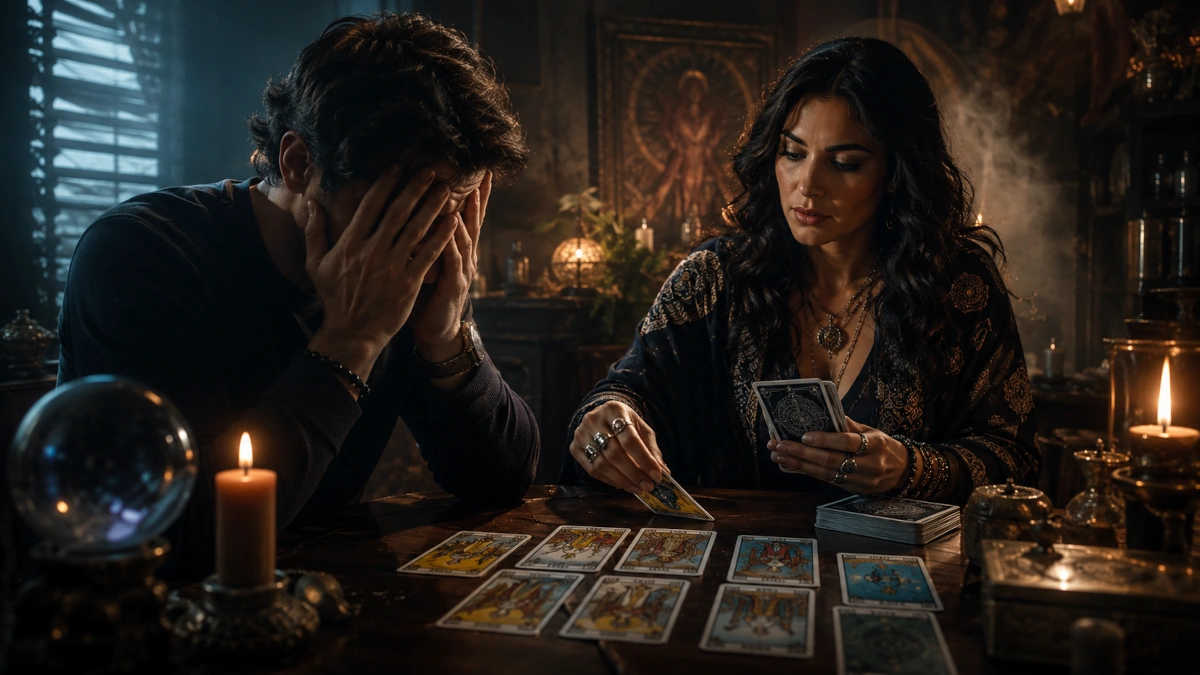
Tarot has fascinated people for generations. The images on the cards tell stories of decisions, hopes, losses, transformations, and those questions for which everyday life rarely offers simple answers. For some, a Tarot reading is a spiritual experience. For others, it is an opportunity to examine their circumstances from an unfamiliar perspective.
Yet however deeply I value Tarot and its symbolic language, there is one thing I firmly believe: Tarot is not the right choice for everyone, nor is it appropriate for every situation.
That may sound unusual coming from someone who reads Tarot professionally. But it is precisely why I consider this distinction necessary.
Responsible guidance does not begin with the promise of having an answer to every question. It begins with a willingness to acknowledge both the possibilities and the limitations of the method being used.
Tarot Is Not a Machine for Predicting the Future
“Will my former partner come back?” — “Will I get the new job?” — “Will I finally find happiness?”
These questions are understandable. Behind them often lie uncertainty, hope, or the desire to leave a difficult situation behind.
Sometimes, what people seek from Tarot above all else is certainty.
But certainty is precisely what a Tarot reading cannot reliably provide.
The future emerges from countless circumstances, decisions, and developments, many of which are neither known nor predictable. A Tarot card cannot transform this complexity into an unquestionable statement.
What it can offer, however, is a different way of approaching the question. What expectations are shaping my decision? Which possibilities am I overlooking? What fears may be influencing my actions?
The cards provide symbols and possible interpretations through which such questions can be explored. Whether these interpretations genuinely apply to a person’s circumstances must be considered carefully.
Tarot should expand our freedom to make decisions, not restrict it through an illusion of predetermined fate.
Not Every Insight Is Comfortable
We all develop ideas about ourselves and the world around us. Some help us find direction; others protect us from uncomfortable realizations.
A Tarot reading may challenge these assumptions.
Perhaps a symbol evokes an unresolved conflict. Perhaps a card suggests a perspective that contradicts what we hope to hear. Or an interpretation that initially seems unfamiliar raises a question we have never considered before.
This can be part of Tarot’s particular fascination.
But an important distinction must be made: An interpretation is not true simply because it is uncomfortable.
Nor does resistance to an interpretation prove that it has exposed some hidden emotional wound.
Sometimes an interpretation simply does not fit. Sometimes the reader lacks important information. And sometimes a symbol suggests a connection that holds no meaning for the person receiving the reading.
A responsible Tarot reading must allow for these possibilities.
Anyone exploring Tarot should be willing to consider unfamiliar ideas. But they are under no obligation to accept them.
When Guidance Becomes Dependence
One aspect of Tarot that concerns me particularly is the attempt to achieve absolute certainty through repeated readings.
A question is asked, the cards are interpreted, but the answer brings no reassurance. So another reading follows, perhaps with a different reader. Then a third.
The hope remains the same: Surely, sooner or later, an answer will appear that removes every doubt.
Yet not every uncertainty can be resolved. Some decisions must be made with incomplete information. Other questions can only be answered through experiences or developments that have yet to unfold.
When someone constantly seeks fresh confirmation in such circumstances, there is a risk of becoming increasingly dependent on external interpretations rather than trusting their own judgment.
That is contrary to my understanding of Tarot.
A good reading should not make you feel that you need another one as soon as possible. It should help you engage with your question more independently.
Sometimes the wiser choice is to step away from the cards, allow some time to pass, and see how the insights from an earlier reading relate to everyday life.
Tarot Cannot Replace Personal Responsibility or Professional Advice
There are situations in life where symbolic reflection can be enriching. But there are also questions for which other forms of guidance are more important.
Health concerns require qualified medical attention. Legal disputes call for professional legal advice. Financial decisions should be based on reliable information and a realistic assessment of risk.
Tarot cannot replace any of these foundations.
Nor should a reading determine whether someone ends a relationship, abandons a career, or suspects another person of a particular action.
The cards may encourage us to examine our feelings and assumptions. They cannot, however, provide verifiable evidence of another person’s intentions or establish what will happen in the future.
Recognizing these limitations does not diminish Tarot’s value in my eyes. On the contrary, acknowledging its boundaries is what makes responsible practice possible.
What a Tarot Reading Can Actually Offer
If Tarot cannot provide certain predictions about the future and should not make our decisions for us, where does its value lie?
For me, it lies primarily in the encounter between a personal question and a symbolic image.
The Tarot contains themes that have occupied the human imagination for centuries: beginnings and loss, power and helplessness, hope and disappointment, attachment and freedom.
Engaging with these images can reveal new connections to our own circumstances.
Sometimes this leads to a surprising insight. Sometimes a thought we already had becomes clearer. And sometimes we simply discover that a particular interpretation does not take us any further.
That, too, is a possible outcome.
A reading does not need to appear mysterious or extraordinary to be meaningful. Its value should not be measured by how astonishing a statement sounds, but by whether it helps someone approach their circumstances with greater clarity and independence.
There is also room for different ways of understanding the experience. Some people perceive Tarot as a form of spiritual resonance. Others experience it as a process of psychological reflection. Still others appreciate the unusual perspectives that emerge through its symbolism.
These differences do not need to be resolved for a meaningful conversation about the cards to take place.
Who Might Benefit from Tarot?
In my experience, Tarot can be particularly valuable for someone who is not simply seeking confirmation, but is genuinely willing to explore a question.
This requires openness to examining one’s own expectations, as well as the freedom to reject an interpretation.
You do not have to believe that the cards possess supernatural powers. Nor do you have to assume that everything a Tarot reader says must be correct.
What matters more is an attitude that combines curiosity with independent thinking.
Anyone approaching a reading should be prepared to consider different perspectives, take responsibility for personal decisions, and tolerate uncertainty where no reliable answer is available.
Above all, one principle should remain clear:
The interpretation belongs to the conversation. The decision belongs to your life.
When I Would Advise Against a Tarot Reading
Not every question calls for the cards.
If you expect an unquestionable prediction, Tarot cannot meet that expectation.
If you hope a reading will relieve you entirely of the responsibility for a difficult decision, it may create additional uncertainty instead.
If you have already received numerous readings about the same question and continue to seek reassurance, taking a break may be more helpful than another interpretation.
And if you are experiencing a personal crisis that requires urgent support, receiving appropriate assistance should take priority.
This does not mean that Tarot is fundamentally unsuitable. It simply means that a responsible practice must also recognize when it is not the right approach.
I consider it more honest to decline a reading than to encourage expectations that cannot be fulfilled.
My Approach: Understanding Rather Than Certainty
Tarot has been part of my life for many years. The more deeply I have explored its symbolism, the greater my respect has become for the questions people bring to the cards.
Behind a seemingly simple question, there may be a long personal story. Behind the desire for a prediction, there may be a fear of making a decision. And behind a skeptical attitude, there is often a perfectly reasonable need for explanations that can be understood and examined.
All of this deserves attention.
That is why I do not regard a Tarot reading as the proclamation of some higher truth. I see it as a shared attempt to understand the deeper meaning of a question.
The cards create a symbolic space. Whatever emerges within that space need not be believed without question. It can be observed, challenged, and placed in context.
The role of a Tarot reader is not to sell certainty, but to make understanding possible.
Is Tarot Right for You?
Perhaps you have never experienced a Tarot reading before. Perhaps you are curious but skeptical. Or perhaps you have had readings in the past that did not entirely convince you.
None of these things is an obstacle.
The important question is not whether you believe in Tarot. It is what you expect from a reading.
If you want to explore a personal question from another perspective, if you are willing to consider unexpected ideas, and if you intend to remain responsible for your own decisions, Tarot may offer a worthwhile experience.
If, on the other hand, you are seeking absolute certainty, binding predictions about the future, or someone else to make your decisions for you, Tarot is probably not what you need.
Tarot isn’t for everyone. But for those willing to ask questions without demanding immediate certainty, it can open a distinctive space for reflection and understanding.
ALARIK TAROT
TAROT & SYMBOLIC INSIGHT
Beyond the Visible. Into the Meaning.
Personal Tarot & Lenormand Readings, Astrology and Mystical Exploration
Request a Personal Reading
Legal Information
Tarot and astrology readings offer symbolic interpretation and personal reflection. They are not a substitute for professional medical, psychological, legal or financial advice.
© 2026 Alarik Tarot · All rights reserved.