Is Tarot a Sin? Spiritual Practice Between Faith and Understanding
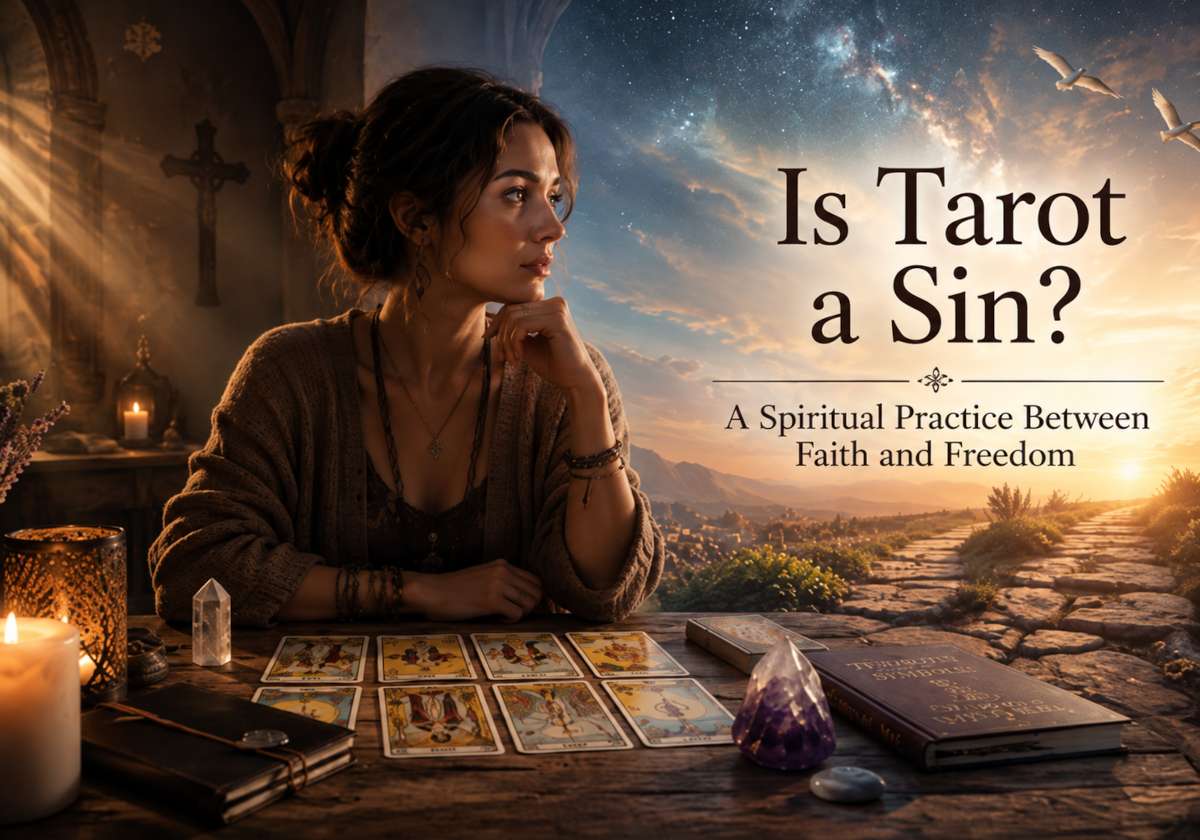
For many spiritual seekers, Tarot is a tool for self-discovery, a mirror of inner processes, and a bridge to the unconscious mind. For others, particularly within conservative religious communities, it is considered a “sin” or even a dangerous occult practice.
Christianity, in particular, is often portrayed as fundamentally incompatible with Tarot and other symbolic systems. But is the relationship really that simple?
This article explores an important question: Is Tarot truly a sin, or is there room for a different understanding of spiritual practice?
What Does the Bible Really Say About Divination and Magic?
Religious objections to Tarot frequently refer to passages from the Old Testament. One of the most commonly cited is Deuteronomy 18:10–12.
In this passage, the Israelites are forbidden from engaging in divination, sorcery, interpreting omens, casting spells, consulting spirits, or seeking guidance from the dead. Such practices are condemned within the religious framework of the text.
These verses are often interpreted as a general prohibition against practices associated with divination.
Yet their historical context deserves consideration.
The passage forms part of the religious laws intended to distinguish ancient Israel from the surrounding cultures and their ritual practices. It addresses divination and forms of spiritual consultation that were regarded as incompatible with Israel’s covenant with God.
Whether these prohibitions also apply to modern Tarot as a psychological or symbolic practice remains a matter of theological interpretation.
Some Christian traditions understand the prohibition broadly and reject Tarot regardless of the reader’s intentions. Others distinguish between attempts to obtain supernatural knowledge and the reflective use of symbols.
Modern Tarot, when approached primarily as a tool for self-examination, does not necessarily serve the same purpose as the ancient practices described in these passages. Nevertheless, this distinction does not resolve every religious objection.
The Bible Also Contains Spiritual Interpretation and Symbolism
Interestingly, the Bible includes numerous accounts in which dreams, visions, and symbolic imagery are understood as meaningful or divinely inspired.
Several examples are particularly relevant.
Joseph – The Interpreter of Dreams (Genesis 40–41)
Joseph interprets the dreams of Pharaoh and others, attributing his ability to God.
His interpretation of Pharaoh’s dreams anticipates seven years of abundance followed by seven years of famine. This insight allows Egypt to prepare for the coming crisis.
Within the biblical narrative, dream interpretation is therefore presented not as a forbidden practice but as a gift exercised through divine guidance.
Daniel – The Interpreter of Visions (Daniel 2)
Daniel interprets King Nebuchadnezzar’s dream, explaining its symbolic imagery and its significance for the future of kingdoms.
As with Joseph, the biblical account attributes the interpretation to divine revelation rather than human magical ability.
The story demonstrates how symbols and visions can carry spiritual meaning within the biblical tradition.
The Book of Revelation
The final book of the New Testament is filled with visionary imagery and symbolic figures: seven seals, four horsemen, a mysterious beast, and a woman clothed with the sun.
These images have inspired centuries of theological interpretation.
While Christian traditions differ in how literally or symbolically they understand particular passages, Revelation clearly demonstrates the importance of symbolic language in religious experience.
Conclusion: The Bible makes extensive use of dreams, visions, and symbols. However, it also distinguishes between forms of revelation considered divinely inspired and practices it explicitly prohibits.
Recognizing this distinction is essential when discussing Tarot from a Christian perspective.
Tarot Today – Between Spirituality and Psychology
Contemporary Tarot practice takes many forms. Some readers approach the cards as instruments of divination, while others use them primarily for psychological reflection, spiritual contemplation, or personal insight.
In my own practice, the emphasis is on:
-
Archetypal imagery and ideas associated with depth psychology, including the work of C. G. Jung.
-
Symbolic processes that encourage self-awareness.
-
Questions and possibilities rather than predetermined predictions.
-
Mindfulness and personal responsibility rather than control or manipulation.
Tarot, understood in this way, creates a space for reflection.
Its purpose is not to impose a future upon someone or claim authority over their decisions. Instead, it offers an opportunity to examine inner dynamics, recognize recurring patterns, and consider personal choices with greater clarity.
Some people integrate Tarot into their existing spiritual beliefs, including prayer and personal contemplation.
For them, the cards may serve as prompts for reflection rather than objects of worship or sources of unquestionable authority.
Whether this approach is compatible with Christianity depends on the theological convictions of the individual and their religious community.
Spirituality and Faith – Must They Be Opposites?
Some Christians reject Tarot entirely. Others find ways to incorporate symbolic reflection into their spiritual lives.
Both positions deserve to be understood within their respective religious frameworks.
Faith is deeply personal, but it is also shaped by traditions, teachings, and communities. For that reason, the relationship between Tarot and Christianity cannot be settled by a single universal answer.
Perhaps a useful question alongside “Is Tarot a sin?” is:
“How can I move through life with awareness, sincerity, and spiritual responsibility?”
Tarot is not a religion, nor does it need to replace faith in God.
For those who choose to use it as a symbolic practice, it may provide an opportunity for inner dialogue and deeper self-awareness.
For others, their religious convictions may lead them to avoid it altogether.
Respecting personal freedom means acknowledging both choices.
Genuine spiritual reflection should make room for conscience, trust, and attentive listening rather than relying on fear.
Tarot Is a Question of Intention, Awareness, and Responsibility
The ethical significance of Tarot depends in part on how it is practiced and what claims are made on its behalf.
Using the cards to explore personal questions is different from using them to frighten someone, create dependency, or claim absolute knowledge of their future.
For me, responsible Tarot practice means approaching every reading with respect, awareness, and transparency.
It also means recognizing the limits of interpretation and respecting the beliefs and decisions of the person seeking guidance.
From this perspective, Tarot can be understood as a tool for reflection rather than manipulation.
Whether it is religiously acceptable, however, remains a question each person must consider in light of their own faith and conscience.
Wenn du Tarot für dich selbst einordnen möchtest
Whether Tarot is compatible with your personal faith cannot be answered in the same way for everyone.
Religious convictions, personal boundaries, and individual understandings of spirituality deserve respect.
If you do not regard Tarot as a substitute for faith or as an infallible means of predicting the future, but rather as an opportunity to explore a personal question from another perspective, you may wish to discover what a reading means to you.
You do not have to accept anything that conflicts with your beliefs.
Your question, your circumstances, and the symbolism of the cards remain at the center of the experience – and the interpretation ultimately belongs to you.
ALARIK TAROT
TAROT & SYMBOLIC INSIGHT
Beyond the Visible. Into the Meaning.
Personal Tarot & Lenormand Readings, Astrology and Mystical Exploration
Request a Personal Reading
Legal Information
Tarot and astrology readings offer symbolic interpretation and personal reflection. They are not a substitute for professional medical, psychological, legal or financial advice.
© 2026 Alarik Tarot · All rights reserved.