Can Tarot Predict the Future or Only Reveal Possibilities?
What can Tarot cards really tell us? On predictions, possibilities, intuition, and the limits of what we can know about the future.
The future holds a peculiar fascination.
We know that it has not yet happened, and yet we think about it constantly. We make plans, fear certain developments, hope for change, and try to draw conclusions from past experiences about what tomorrow might bring.
Sometimes we succeed remarkably well. At other times, even our most carefully considered expectations are overturned by a single unexpected event.
Perhaps it is precisely this uncertainty that explains why people have consulted oracles for centuries.
Today, Tarot remains one of the best-known forms of divination.
But what actually happens when we draw cards and ask about an event that has not yet occurred?
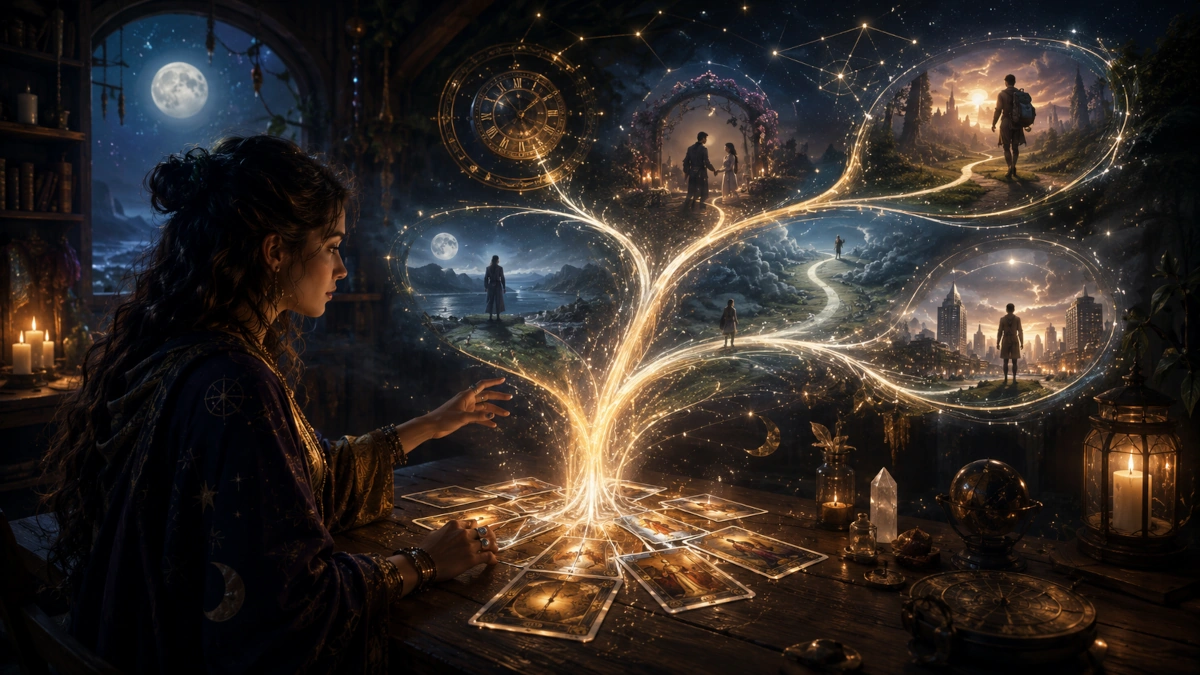
Do we recognize something that is already approaching? Are we considering possible developments arising from our present circumstances? Or do the answers emerge only through our interpretation of the images?
The question of whether Tarot can predict the future leads directly to another: What does it actually mean to know something about the future?
1. Tarot and the Long Tradition of Fortune-Telling
Tarot originated in the fifteenth century as a card game.
Its use as an esoteric system of interpretation developed considerably later, particularly in eighteenth-century France.
Jean-Baptiste Alliette, known as Etteilla, made important contributions to the practice of cartomancy. Over the following centuries, various esoteric schools connected Tarot with astrological, Kabbalistic, and magical ideas.
Within these traditions, Tarot cards were also used to make statements about future events.
Even today, many questions addressed to the cards concern what lies ahead.
Will I begin a new relationship? Will my career circumstances change? How might a personal conflict develop?
Such questions are understandable.
They often arise when a decision matters greatly but essential information is missing.
However, the historical fact that Tarot has been used for fortune-telling does not demonstrate that the cards can actually reveal future events.
For such a claim to be established, the relevant predictions would need to be tested under clearly defined and reproducible conditions.
2. What Is the Difference Between a Prediction and a Trend?
In discussions of Tarot, the terms prediction and trend are often used as though they describe two fundamentally different abilities.
Yet the distinction is not quite so simple.
A prediction describes an event expected to occur at some future point.
A trend, by contrast, refers to an identifiable direction or development from which certain possibilities may arise.
Consider an everyday example.
A company has been losing customers for several months. At the same time, its costs are increasing.
Based on this information, it is reasonable to conclude that its financial position may deteriorate unless corrective measures are taken.
That is a recognizable trend.
It is based on observable data and understandable relationships.
If, however, a Tarot card is drawn and a reader concludes that the company is approaching a financial crisis, there is initially no comparable empirical foundation.
The card may be interpreted as a symbol of uncertainty, loss, or necessary change.
But it does not demonstrably reveal how the company will actually develop.
A trend does not become reliable merely because it is expressed more cautiously than a specific prophecy. What matters is the evidence on which the statement is based.
This distinction is essential to the responsible use of Tarot.
3. Is the Future Already Predetermined?
The idea of a predetermined future appears in numerous religious, philosophical, and spiritual traditions.
Other worldviews, by contrast, emphasize the openness of future events and the importance of human decisions.
Even within philosophy, the relationship between determinism and free will remains a subject of unresolved debate.
For Tarot practice, these perspectives give rise to different models of interpretation.
The Deterministic Model
According to this view, the future follows a course that is fundamentally already fixed.
An oracle might therefore be capable of recognizing events that have not yet occurred but will inevitably take place.
There is no reliable scientific evidence that Tarot possesses such an ability.
The Model of Possible Developments
In this approach, the future is not understood as an entirely predetermined sequence of events.
Instead, different possibilities are considered, influenced by decisions, external circumstances, and the actions of other people.
Within this framework, a Tarot reading may be used to reflect symbolically on such possibilities.
The cards do not, however, automatically reveal which development is actually most likely.
The Reflective Model
A third approach does not regard Tarot as a source of information about future events, but as an opportunity to examine our own expectations and fears.
The question then becomes less:
“What will happen?”
And more:
“Which possibilities can I see, which am I overlooking, and how do I deal with uncertainty?”
This approach does not require any supernatural predictive ability.
Nevertheless, it may hold personal significance because it directs attention toward our own attitude to the future.
4. Why We Can Sometimes Anticipate the Future Remarkably Well
Human beings possess a remarkable ability to develop expectations from experience and observation.
We recognize habits, social dynamics, and recurring patterns.
An experienced person may therefore sense a development at an early stage without immediately being able to explain the basis of that judgment.
Such intuitive assessments can emerge from unconsciously processed experiences and learned patterns.
They are not, however, infallible.
We frequently overestimate the significance of striking events, seek confirmation of our expectations, or confuse personal hopes with probable developments.
These mechanisms can also play a role in Tarot readings.
A reader who discusses a career situation in detail with someone may receive numerous clues about existing conflicts or approaching decisions.
From these clues, the reader may develop a reasonable assessment.
If that assessment later proves accurate, it does not necessarily mean that the cards themselves provided information about the future.
The conclusion may equally have emerged from experience, conversation, and ordinary pattern recognition.
This does not necessarily diminish its practical value.
It does, however, change the explanation of how the assessment came about.
5. What Role Does Intuition Play?
Intuition holds an important place in many forms of Tarot interpretation.
Some readers report that spontaneous images, thoughts, or feelings arise during a reading and seem to extend beyond established card meanings.
Such experiences can be deeply impressive.
Yet their intensity alone tells us nothing about whether they contain accurate information about future events.
An intuitive impression may arise from unconsciously processed experience. It may be shaped by expectations or emerge from a spontaneous association with a card’s imagery.
Whether other explanations are required cannot be determined from subjective experience alone.
For this reason, I consider it important not to present intuitive impressions prematurely as certainties.
They may inspire a thought, deepen a question, or suggest an unusual connection.
But if they lead to a specific statement about a future event, that statement must, in principle, remain open to verification.
Intuition is an experience. Whether it conveys knowledge is another question.
6. An Example: What Can Three Cards Tell Us About a Future Relationship?
Imagine someone asking:
“Will I begin a new romantic relationship within the next few months?”
In an illustrative three-card spread, the following cards appear:
The Hermit — The Lovers — Wheel of Fortune
Within traditional Tarot interpretation, these cards carry different symbolic meanings.
The Hermit is often associated with withdrawal, self-examination, and the search for inner guidance.
The Lovers represents, among other things, relationships, connection, and significant decisions.
Wheel of Fortune symbolizes change, shifting circumstances, and the unpredictability of certain developments.
The Traditional Predictive Interpretation
A Tarot reader might interpret this sequence as suggesting that an important encounter or relationship decision is approaching after a period of solitude.
Wheel of Fortune might be understood as a sign of an unexpected turn of events.
Such an interpretation is understandable within certain Tarot traditions.
It does not, however, prove that a new relationship will actually begin.
The Symbolic Interpretation
The same sequence can be read differently.
The Hermit might raise questions about the current importance of solitude and independence.
The Lovers could encourage reflection on desires, expectations, and decisions within relationships.
Wheel of Fortune might serve as a reminder that encounters and life circumstances cannot be controlled entirely.
This approach does not produce a prediction.
Instead, the cards provide an opportunity to explore one’s own attitude toward possible relationships.
What Is the Essential Difference?
Both interpretations use the same cards.
The first makes a statement about a future event.
The second uses the cards to reflect on present attitudes and possible courses of action.
Only the first interpretation can be tested as a prediction against whether the event subsequently occurs.
The second must be evaluated according to whether it is coherent and offers a meaningful perspective to the person receiving the reading.
These two forms of interpretation should not be confused.
7. Can Tarot Cards Reveal Hidden Developments?
Esoteric literature frequently claims that Tarot can reveal hidden influences, energetic currents, or unconscious dynamics.
Such terms may have particular meanings within spiritual worldviews.
They are not, however, automatically scientifically defined or measurable phenomena.
In particular, it has not been demonstrated that Tarot cards can identify actual hidden events or developments independently of existing information.
This does not mean that a reading can never lead to a surprising insight.
An unusual image may encourage someone to look at a situation differently.
A conversation may bring previously overlooked information into focus.
Or an interpretation may raise a question that the person has so far avoided.
But such experiences should not automatically be regarded as evidence of supernatural knowledge.
The distinction between a helpful interpretation and an accurate statement about an unknown reality remains essential.
8. Are There Favourable and Unfavourable Times?
In some Tarot traditions, cards are also used to identify particular time periods or favourable moments for making decisions.
A card might, for example, be interpreted as indicating delay, acceleration, or an approaching conclusion.
Other methods associate cards with seasons, astrological correspondences, or particular periods of time.
These practices have an esoteric tradition.
There is, however, no convincing scientific evidence that they can reliably identify objectively favourable moments or specific dates for future events.
Practical decisions should therefore be based on verifiable circumstances.
Someone planning a career change, for example, should consider application deadlines, contractual conditions, and financial obligations.
Someone hoping to resolve an important relationship issue should pay attention to willingness to communicate, mutual respect, and the actual circumstances involved.
A Tarot card may raise the question of whether patience or decisive action would be more appropriate.
It cannot replace a factual examination of the situation.
9. How Can a Tarot Prediction Be Tested?
Anyone wishing to determine whether Tarot can genuinely predict future events needs more than a few impressive examples.
A testable prediction should be recorded before the event in question occurs.
It should be formulated as clearly as possible and include an identifiable time frame.
The conditions under which it would count as accurate or inaccurate must also be established in advance.
Consider two statements.
“Something in your life will change soon.”
This formulation is so open-ended that numerous later events could be associated with it.
Now consider a different statement:
“Within the next eight weeks, you will receive a written job offer from a new employer.”
Here, both the event and the time frame are much more clearly defined.
Such a statement can be tested afterward.
But even a single accurate prediction does not establish a special ability.
Coincidental successes are also possible.
To establish reliable predictive performance, a larger number of predictions recorded in advance would need to be evaluated systematically against an appropriate comparison standard.
Unsuccessful predictions would also have to be included.
This methodological distinction matters because people tend to remember striking successes particularly well.
A responsible investigation of Tarot practice must therefore also examine the predictions that did not come true.
10. Why Questions About the Future Can Still Be Meaningful
The absence of scientific confirmation of Tarot’s predictive ability does not mean that every attempt to explore questions about the future is meaningless.
Human beings must make decisions without knowing all their consequences.
We cannot calculate every possible development or eliminate every uncertainty.
That is precisely why it can be helpful to consider different scenarios consciously.
A Tarot reading may provide a symbolic framework for doing so.
In a career-related decision, one card might bring the theme of security into focus, another the willingness to embrace change, and a third the importance of long-term goals.
The cards do not calculate probabilities.
They may, however, encourage consideration of different aspects of a decision.
The same applies to personal relationships, family changes, or questions about the direction of one’s life.
The value then does not arise from supposedly certain knowledge of what lies ahead.
It arises from the opportunity to engage more consciously with a future that remains uncertain.
11. The Danger of Self-Fulfilling Prophecies
A prediction can influence a person’s behaviour.
If someone becomes convinced that a relationship will fail, they may begin acting more suspiciously or withdrawing emotionally.
This behaviour can, in turn, damage the relationship.
Conversely, a positive prediction may encourage someone to act with greater confidence and recognize new opportunities.
Such processes are often discussed under the concept of the self-fulfilling prophecy.
They demonstrate that a prediction need not remain a passive description.
It can itself become a factor influencing later developments.
This creates a particular responsibility within Tarot practice.
Statements about separation, illness, financial loss, or other distressing events should not be presented as inevitable certainties.
Positive promises can also be problematic if they encourage people to make poorly considered decisions.
Responsible guidance should therefore avoid creating the impression that the cards have already determined someone’s personal destiny.
12. My Approach: Between Openness and Verifiability
In my work with Tarot and Lenormand, I am particularly interested in the question of possible future predictions.
It touches upon a fundamental problem: How can we distinguish between a symbolic interpretation that holds personal meaning and one that genuinely contains information beyond what we already know?
This question cannot be answered through blanket rejection or uncritical acceptance.
Anyone claiming that Tarot can reveal future events is making a testable claim.
Someone who uses Tarot as a symbolic tool for reflection, by contrast, is following a different approach.
Both perspectives can be examined, but they should not be confused.
For me, openness toward unusual experiences does not mean accepting every proposed explanation as true.
It means taking observations seriously, examining their possible causes, and distinguishing between interpretation, personal experience, and verifiable claims.
I consider this approach especially important when dealing with questions about the future.
For the uncertainty of what lies ahead is not a defect that we must eliminate at any cost.
It is part of the human condition.
Perhaps the most interesting question we can ask of Tarot is not whether the future is already concealed within the cards, but what our interpretations reveal about the way we confront uncertainty.
13. What Can Tarot Cards Actually Offer?
Tarot has a long tradition as a method of divination.
Within that tradition, cards are interpreted as indications of future events, possible developments, and personal decisions.
However, this does not establish a scientifically demonstrated ability to predict future events reliably.
Even the claim that Tarot can identify genuine future trends would require verification if it is intended to mean more than the symbolic exploration of possible scenarios.
What Tarot can offer, however, is a distinctive approach to questions that concern us.
Its images may open unfamiliar perspectives, bring personal expectations into focus, and encourage reflection on different courses of action.
Whether this leads to a helpful insight depends on more than the cards themselves.
The question being asked, the quality of the interpretation, and the willingness to examine one’s own assumptions critically are all essential.
The future remains subject to decisions, external influences, and unexpected events. A Tarot reading should not replace this openness with unfounded certainty.
Which Possibilities Would You Like to Explore for Your Future?
Perhaps you are facing an important decision.
Perhaps you are wondering how a relationship might develop, what opportunities a career change could offer, or how to navigate an uncertain period in your life.
A personal Tarot reading can provide a setting in which we explore your question and different possible developments through symbolic interpretation.
The aim is not to guarantee future events, but to examine your present circumstances, expectations, and possibilities for action with care.
If you would like to explore this approach, we can consider your question about the future together.
ALARIK TAROT
TAROT & SYMBOLIC INSIGHT
Beyond the Visible. Into the Meaning.
Personal Tarot & Lenormand Readings, Astrology and Mystical Exploration
Request a Personal Reading
Legal Information
Tarot and astrology readings offer symbolic interpretation and personal reflection. They are not a substitute for professional medical, psychological, legal or financial advice.
© 2026 Alarik Tarot · All rights reserved.