The High Priestess: The Mystery of the Hidden
On Duality, Inner Knowing, and the Art of Living with Uncertainty
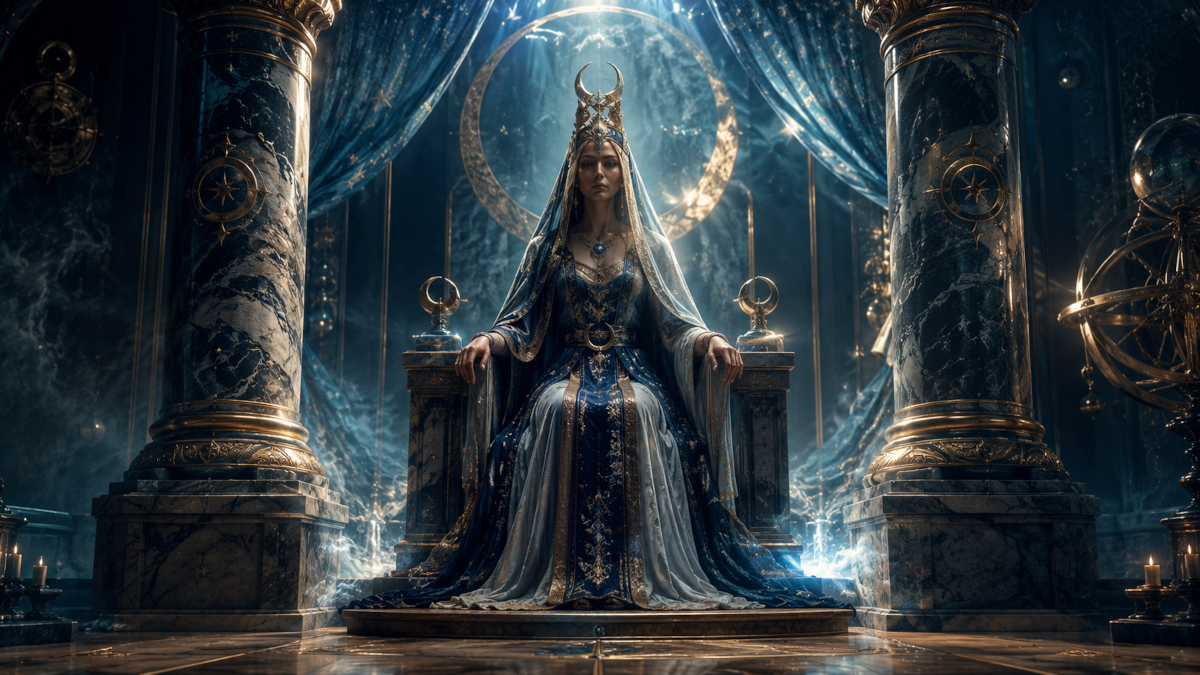
The High Priestess is one of the most enigmatic figures in the Tarot. She sits motionless between two pillars, a partially concealed scroll resting in her lap. Behind her hangs a veil, hiding whatever lies beyond the threshold she guards.
Nothing about her urges us to act. She promises no triumph, demands no decision, and proclaims no absolute truth. Instead, her presence seems to raise a question: What happens when we stop searching for immediate answers?
In a world that equates knowledge with accessibility and understanding with explanation, the High Priestess embodies a different attitude. She reminds us that there is a space between perception and understanding, one we cannot always cross at will.
Her mystery is not that she possesses a hidden truth. It is that she leads us to the limits of what we know.
The Two Pillars: The Principle of Duality
In the Rider–Waite–Smith Tarot, the High Priestess sits between a black pillar and a white one. They bear the letters B and J, referring to Boaz and Jachin, the two pillars at the entrance to Solomon’s Temple described in the First Book of Kings.
In later Western esoteric traditions, these pillars acquired a broader symbolic significance. They became associated with the opposites that shape our perception of the world: light and darkness, activity and stillness, the conscious and the unconscious, revelation and mystery.
Yet the High Priestess belongs to neither side.
She sits between them.
This distinction matters. Duality does not necessarily mean that one opposite must overcome the other. Sometimes understanding emerges precisely because we learn to perceive both sides at once.
Light reveals, but it can also blind. Darkness conceals, yet it also allows for retreat and reflection. Conscious awareness gives structure to our experiences, while unconscious processes influence our perceptions in ways we may not immediately recognize.
The High Priestess does not ask us to choose between these poles. She invites us to consider their relationship.
The mystery lies not in opposition alone, but in the space that emerges between opposites.
The Veil: The Boundary Between Perception and Understanding
Behind the High Priestess hangs a veil decorated with pomegranates and palms. It separates the visible foreground from a space that remains beyond our immediate sight.
In esoteric interpretations, this veil is often understood as the boundary between the material and spiritual worlds.
But its meaning can extend further.
Our everyday perception has a veil of its own. We observe actions without always knowing the motives behind them. We hear words without knowing every thought from which they arose. We experience emotions whose origins may initially remain obscure.
What we perceive is never the entirety of what exists.
The High Priestess makes this limitation visible without rushing to fill it with a supernatural explanation.
She confronts us with an epistemological question: How do we respond to what we experience but do not yet understand?
Not every sensation points toward a hidden reality. Not every intuition leads to an accurate insight. Nevertheless, experiences for which we initially lack the words may provide a reason to investigate further.
The veil thus becomes a symbol of a boundary that should neither be denied nor crossed carelessly.
The Hidden Scroll: Knowledge That Has Not Yet Found Its Language
In the Rider–Waite–Smith Tarot, a scroll bearing the inscription TORA rests in the High Priestess’s lap, partially concealed by her robes.
It evokes sacred teaching, tradition, and hidden knowledge. At the same time, it reminds us that the mere presence of a written text does not make its meaning accessible.
A book may lie open before us without our understanding its contents. A thought may feel familiar even when we cannot explain it. And sometimes it is only in retrospect that we recognize the significance an earlier experience held for us.
Here, the symbolism of the High Priestess touches upon a fundamental characteristic of human understanding.
Not everything we know can be readily expressed in words.
We recognize familiar voices, notice subtle changes in the atmosphere of a conversation, or make decisions based on years of experience without being able to describe every step of our reasoning.
Such forms of implicit knowledge should not be confused with supernatural insight. They do, however, demonstrate that human understanding encompasses more than consciously articulated conclusions.
In this interpretation, the High Priestess is not an all-knowing oracle. She represents the possibility that meaning reveals itself gradually.
Intuition: Between Experience and Error
Few Tarot cards are as closely associated with intuition as the High Priestess.
But what does intuition actually mean?
In everyday life, we speak of sensing something without knowing why. A decision feels right, a situation seems strange, or an encounter feels unexpectedly familiar.
Such impressions may arise from experiences that our conscious minds have not fully processed or explicitly remembered. Yet they can also be shaped by expectations, fears, and prejudices.
Intuition, therefore, is neither inherently unreliable nor an infallible source of hidden truth.
This is precisely where an important lesson of the High Priestess emerges.
She does not encourage us to follow every inner impulse blindly. Rather, she reminds us to acknowledge those impulses without immediately mistaking them for certainty.
An intuitive impression may be the beginning of a question. It is not yet the answer.
Recognizing this distinction allows us to bring intuition and critical thinking together instead of treating them as opposing forces.
The High Priestess does not ask us to abandon reason. She asks us to notice what reason has not yet been able to explain.
Stillness as a Space for Understanding
The Magician, the first numbered card of the Major Arcana, stands before a table filled with tools. His posture is active, his attention directed toward the possibilities of action.
The High Priestess, by contrast, remains seated.
While the Magician directs his abilities outward, she seems to turn her attention inward.
This contrast represents more than a distinction between activity and passivity.
We live in an environment that rewards immediate responses. Messages demand replies, problems demand decisions, and uncertainty seems to demand explanation. Even personal experiences are frequently judged and categorized before we have had time to reflect upon them.
Yet not every question benefits from speed.
Sometimes our understanding of a situation changes only when we give it time. A conversation takes on a different meaning in retrospect. A reaction that initially seemed incomprehensible begins to make sense. A thought we had pushed aside returns in a different form.
The stillness of the High Priestess is therefore not emptiness, but a form of attentive restraint.
It does not mean postponing decisions indefinitely. It simply reminds us that action and understanding may follow different rhythms.
Sometimes we must act even though we do not yet know everything. At other times, the wiser course is to observe more carefully before proceeding.
The Moon: The Light of Uncertainty
The Moon is another important symbol associated with the High Priestess. In the Rider–Waite–Smith Tarot, a crescent moon appears at her feet.
Across mythology and spiritual symbolism, the Moon carries numerous meanings. It is associated with change, recurring cycles, night, dreams, and the unconscious.
Unlike the Sun, the Moon produces no visible light of its own. What we perceive as moonlight is reflected sunlight.
This creates a remarkable symbolic parallel.
Understanding, too, often emerges not through direct revelation but through reflection. We reconsider an experience from another perspective, recognize connections through conversation, or discover something in an image that previously escaped our attention.
Moonlight makes a landscape visible, but never with the clarity of daylight.
Some contours emerge while others disappear.
In this way, the High Priestess reminds us that understanding exists in varying degrees of clarity. Between complete ignorance and established certainty lies a vast territory of assumptions, experiences, and provisional interpretations.
Learning to remain within this territory without filling it prematurely with answers is one of her central challenges.
The High Priestess in a Tarot Reading
What does it mean when the High Priestess appears in a personal Tarot reading?
There is no universally valid answer.
Her meaning emerges from the relationship between the question being asked, her position within the spread, the surrounding cards, and the personal circumstances of the person seeking guidance.
Nevertheless, her symbolism suggests certain directions for reflection.
In a relationship reading, for example, she might point toward unspoken expectations, missing information, or the need for a more attentive conversation. She does not, however, prove that a partner is hiding something.
In a career-related decision, she might encourage a closer examination of the available information or a deeper consideration of one’s own motivations.
During a period of personal change, she might symbolize a desire for solitude, self-observation, or an inner development that has not yet reached its conclusion.
What matters is that such interpretations open possibilities rather than claim to establish facts that cannot be determined from the cards alone.
The High Priestess does not necessarily indicate a secret that someone is keeping from us.
Sometimes she simply reminds us that we ourselves do not yet know enough.
Three Questions from the High Priestess
When exploring this card, you can apply its symbolism to your own circumstances.
What am I perceiving without yet being able to explain it adequately?
This question invites us to take intuitive impressions seriously without accepting them uncritically as facts.
Which opposing forces currently shape my thinking?
Perhaps you find yourself caught between security and change, closeness and independence, or the desire for clarity and the fear of making a decision. The High Priestess encourages us to examine both sides more carefully.
Where might it be wiser to observe before taking action?
Not every uncertainty requires an immediate answer. Sometimes one additional piece of information is more valuable than a hasty decision.
These questions make no claim to reveal hidden truths. Their value lies in broadening our awareness.
The True Mystery of the High Priestess
The High Priestess is often described as the guardian of secret knowledge. Yet perhaps her deeper meaning does not lie in the promise of a final answer waiting behind her veil.
Perhaps the mystery is that we can never possess reality in its entirety.
We perceive fragments, establish connections, revise our assumptions, and discover new questions. What seems self-evident today may require a different interpretation tomorrow.
The High Priestess embodies this openness toward the unknown.
She sits between light and darkness, between what is spoken and what remains unspoken, between knowledge and conjecture. She does not choose one side, because her meaning arises from the relationship between them.
Here, too, we find her connection to the Tarot as an instrument of symbolic reflection.
The cards need not proclaim supernatural truths in order to raise questions that lead us beyond our habitual patterns of thought.
The High Priestess does not reveal every secret. She teaches us how to encounter mystery without feeling compelled to explain it too soon.
What Does the High Priestess Mean for Your Personal Question?
Perhaps the High Priestess appears at a time when you are standing between two possibilities. Perhaps you are concerned about a relationship, a change, or a decision whose full significance you cannot yet see.
The card may be an invitation to look more closely: at what you already know, at what you merely suspect, and at the questions that have so far remained unnoticed.
The meaning she takes on in an actual reading, however, depends on your personal circumstances and the entire arrangement of cards.
If you would like to move beyond general symbolism and explore a question of your own, we can examine it together through a personal Tarot reading.
ALARIK TAROT
TAROT & SYMBOLIC INSIGHT
Beyond the Visible. Into the Meaning.
Personal Tarot & Lenormand Readings, Astrology and Mystical Exploration
Request a Personal Reading
Legal Information
Tarot and astrology readings offer symbolic interpretation and personal reflection. They are not a substitute for professional medical, psychological, legal or financial advice.
© 2026 Alarik Tarot · All rights reserved.