Sun, Moon, and Rising Sign: The Big Three in Your Birth Chart
What astrology’s “Big Three” mean — and why their relationship reveals a more complex symbolic picture than your Sun sign alone.
When people are asked about their zodiac sign, they usually name one of the twelve signs: Aries, Taurus, Gemini, or one of the remaining nine.
What they generally mean is the sign in which the Sun was located at the time of their birth, according to the astrological zodiac being used.
But a birth chart contains far more than this single position.
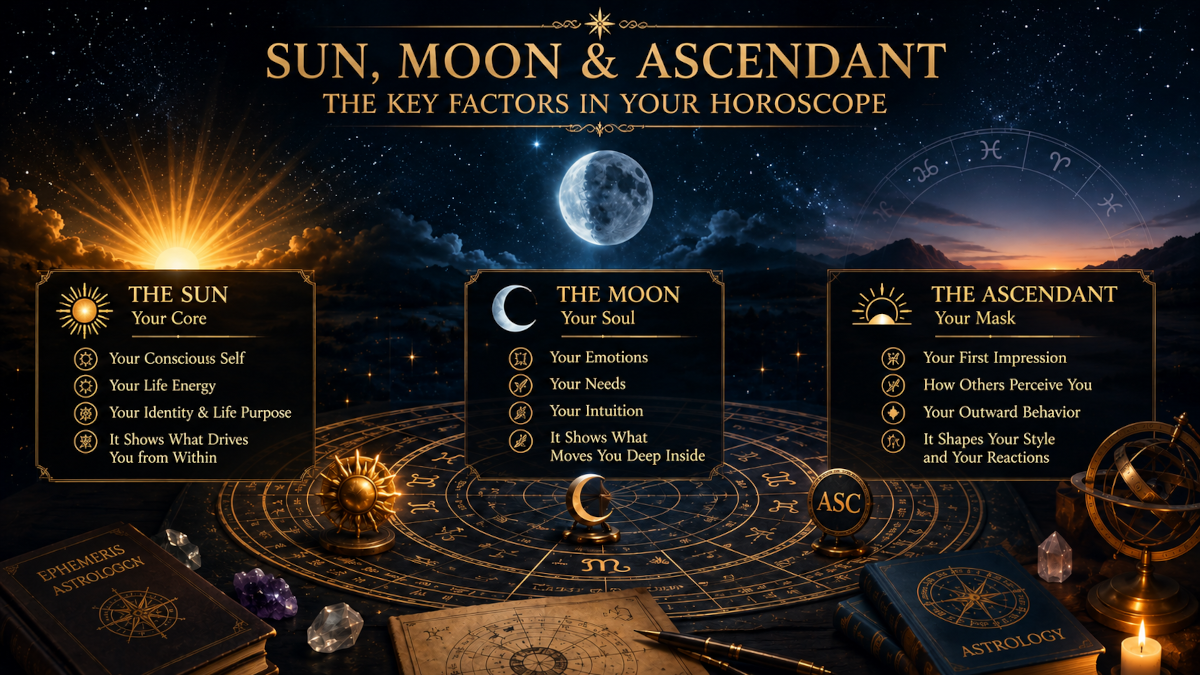
Among the most important factors in modern Western astrology are the Sun, Moon, and Ascendant, commonly known as the Big Three.
In astrological symbolism, they represent different dimensions of human experience: our conscious sense of identity, our emotional inner world, and the way we encounter our surroundings.
Their significance, however, does not emerge simply by placing three zodiac signs side by side.
It is the relationship between them that allows for the more nuanced interpretation distinguishing a personal birth chart from a general description of a zodiac sign.
The Sun, Moon, and Rising Sign are therefore less like three ready-made answers and more like three different perspectives on the same person.
1. The Sun: Identity, Will, and Conscious Self-Expression
The Sun occupies a central position within astrological tradition.
Astronomically, it is the star at the centre of our solar system and the most important source of energy for life on Earth.
In astrological symbolism, this central importance is extended to the human sense of self.
The Sun represents identity, vitality, creative expression, and the conscious shaping of one’s life.
It is associated with questions about how individuals develop their identity and which values or goals provide direction for their actions.
What Does Your Sun Sign Mean?
Within astrology, the Sun sign describes a particular symbolic quality.
The Sun in Leo, for example, is traditionally associated with expressiveness, creativity, self-confidence, and the desire for recognition.
The Sun in Virgo, by contrast, is often linked to analysis, discernment, practical abilities, and attention to detail.
These associations, however, are not reliable psychological personality assessments.
Not everyone with a Leo Sun is extroverted, and not everyone with a Virgo Sun possesses exceptional analytical abilities.
Astrological characteristics are better understood as interpretative themes through which personal experiences can be explored.
The Sun as a Question About Your Own Path
For me, something more interesting than assigning individual personality traits is the symbolic question associated with the Sun:
How do I want to shape my life consciously?
This question concerns self-understanding, personal goals, and how we approach our own possibilities.
From this perspective, the Sun does not symbolize an unchanging essence that was fully determined at birth.
Instead, it represents the process through which people develop an understanding of who they want to become and the place they wish to occupy in the world around them.
2. The Moon: Emotions, Needs, and Inner Security
While the Sun is often associated with conscious identity in astrological interpretation, the Moon directs attention toward our emotional world.
Astronomically, the Moon is Earth’s natural satellite. Its changing appearance and regular cycle have influenced calendars, mythologies, and religious beliefs for thousands of years.
In astrology, it is traditionally associated with feelings, habits, needs, and the experience of emotional security.
It symbolizes aspects of life that are not determined exclusively by conscious decisions.
What Does Your Moon Sign Describe?
Your Moon sign refers to the zodiac sign in which the Moon was located at the time of your birth.
In traditional astrological interpretation, a Moon in Scorpio, for example, is associated with intense emotions, a need for emotional depth, and heightened sensitivity to trust and vulnerability.
A Moon in Gemini, on the other hand, is often linked to emotional flexibility, curiosity, and a desire for communication.
These descriptions are symbolic interpretations, not scientifically established statements about a person’s actual emotional life.
Nevertheless, they may provide an opportunity to reflect on personal experiences.
Perhaps you recognize yourself in a particular theme. Perhaps it contradicts your self-image. Even that contradiction can raise an interesting question.
The Moon and the Need for Emotional Security
One of the central questions associated with the astrological Moon is:
What do I need in order to feel emotionally safe and secure?
The answers can vary considerably.
Some people find security in familiar relationships, others in independence, stability, or the opportunity to withdraw and spend time alone.
Astrological interpretation can address these themes symbolically. It cannot, however, determine someone’s actual emotional needs from the Moon’s position alone.
Personal experience, life history, and individual feelings remain essential.
3. The Rising Sign: The Threshold Between Self and World
The Ascendant, also known as the Rising Sign, differs fundamentally from the Sun and Moon.
It is not a celestial body.
Astronomically, the Ascendant is the point on the ecliptic rising above the eastern horizon at a particular time and location.
Because Earth rotates, this point changes continuously throughout the day.
Calculating it accurately therefore requires not only the date of birth but also the birth time and birthplace.
Within Western astrology, the Ascendant holds particular importance because, in many house systems, it provides the starting point for dividing the birth chart into astrological houses.
What Does the Ascendant Mean in Astrology?
Traditionally, the Ascendant is associated with outward appearance, physical presentation, one’s approach to life, and the initial encounter with the outside world.
In modern popular astrology, it is often described as the face we show to the world.
This description is vivid, but somewhat limited.
In many astrological traditions, the Ascendant represents more than an external mask. Rather, it symbolizes the starting point from which a person encounters their surroundings.
Aries Rising, for example, is associated with initiative, directness, and the impulse to act.
Libra Rising is often linked to balance, relationship-oriented behaviour, and the search for harmony.
Whether these characteristics genuinely describe an individual cannot be reliably determined from the Ascendant alone.
The Ascendant as a Symbolic Threshold
The astronomical meaning of the Ascendant already contains a remarkable image.
At the eastern horizon, celestial bodies appear to enter the visible sky as a result of Earth’s rotation.
The Ascendant thus marks a threshold between what has not yet become visible and what is emerging into view.
Symbolically, this threshold can be related to the encounter between inner experience and the external world.
How do I approach unfamiliar situations? What expectations do I bring into encounters with others? How does my self-image differ from the impression other people actually have of me?
These questions cannot be answered by a zodiac sign.
They can, however, become subjects of personal reflection within an astrological interpretation.
4. How the Sun, Moon, and Rising Sign Work Together
The particular significance of the Big Three emerges from their relationship.
The Sun is commonly associated with conscious identity and the way we shape our lives.
The Moon symbolizes emotional needs and inner responses.
The Ascendant represents, in symbolic terms, the way we encounter our environment.
These three dimensions may appear harmonious, but they can also suggest different needs and patterns of behaviour.
An Astrological Example
Imagine a person with the following combination:
-
Sun in Scorpio: Symbolically associated with intensity, determination, and the desire to look beneath the surface.
-
Moon in Pisces: Traditionally linked to sensitivity, imagination, and emotional receptivity.
-
Leo Rising: Often associated with confident presentation, expressiveness, and a noticeable presence.
An astrological interpretation might develop the image of someone who appears determined and self-assured outwardly, while experiencing considerable sensitivity internally and placing great importance on emotional depth.
This is not a definitive personality description.
Instead, the combination provides a symbolic starting point for questions.
Does this person actually experience a difference between their outward appearance and their inner feelings?
Are there situations in which the desire for recognition conflicts with the need for solitude?
Or does the interpretation fail to describe the person at all?
A nuanced astrological approach must allow for this final possibility as well.
The meaning of a birth chart combination does not depend on every traditional association being accurate, but on the conscious examination of the interpretations it offers.
5. Why Your Sun Sign Alone Is Not Enough
General daily, weekly, or monthly horoscopes usually focus exclusively on the Sun sign.
This makes them easily accessible, but it also reduces astrological interpretation to a small part of the overall system.
A complete birth chart takes many more factors into account.
Alongside the Sun, Moon, and Ascendant, astrologers examine the positions of other planets, the astrological houses, and the angular relationships between celestial bodies.
These angular relationships are called aspects.
Among the best-known are the conjunction, opposition, square, trine, and sextile.
Within astrological tradition, they are interpreted as indicating different relationships between the symbols involved.
The placement of the Sun or Moon within an astrological house also changes the thematic emphasis according to this interpretative framework.
A Sun in Leo, for example, is interpreted differently depending on whether it occupies the tenth house or the fourth house.
The tenth house is traditionally associated with public standing, career, and social roles, while the fourth house is often linked to origins, family, and personal roots.
This creates a more complex symbolic representation than the Sun sign alone.
Complexity, however, does not automatically mean scientific accuracy.
A detailed horoscope contains more astrological information and offers more possibilities for interpretation. It does not follow that it can reliably predict a person’s personality or future.
6. How Are the Sun, Moon, and Rising Sign Calculated?
Astrological interpretation begins with astronomically calculable positions.
It is important here to distinguish between calculation and interpretation.
The positions of celestial bodies at a particular moment can be determined using astronomical models.
The astrological meanings attributed to those positions, however, belong to a symbolic system of interpretation.
What Birth Details Are Required?
Three pieces of information are generally important when creating a birth chart:
Date of birth: This provides the basis for calculating the positions of celestial bodies.
Time of birth: This is particularly important for determining the Ascendant and astrological houses. The Moon’s precise position also depends on the time of birth.
Place of birth: This is needed to establish local celestial coordinates and the position of the horizon.
From a geocentric perspective, the Sun moves approximately one degree per day along the ecliptic. For this reason, the Sun sign can often be determined from the date of birth alone.
However, for births occurring close to the transition between zodiac signs, the exact time may be decisive.
The Moon moves through the zodiac much faster, changing signs approximately every two and a half days on average.
The Ascendant changes even more rapidly. On average, a particular zodiac sign occupies the eastern horizon for approximately two hours, although the actual duration depends on latitude and the sign involved.
An inaccurate birth time can therefore result in an incorrect Rising Sign.
Which Zodiac System Is Used?
The choice of astrological zodiac also matters.
Modern Western astrology predominantly uses the tropical zodiac, whose starting point is linked to the vernal equinox.
Other traditions, including many forms of Indian astrology, use a sidereal zodiac oriented toward the stars.
Because of the precession of Earth’s axis, the positions defined by these two systems no longer coincide.
Consequently, the same birth can produce different zodiac sign placements depending on which system is used.
This is not a calculation error, but the result of different astrological reference systems.
7. What a Birth Chart Can — and Cannot — Tell You
Astrology has a long cultural history.
For centuries, it was closely connected with astronomy, philosophy, medicine, and religious worldviews.
Its concepts and symbols have influenced the thinking of many societies.
But historical significance and scientific validity are different questions.
There is no convincing scientific evidence that the positions of the Sun, Moon, and Ascendant at the time of birth determine a person’s personality in the manner claimed by astrology.
Nor can a birth chart reliably establish which events will occur in someone’s life.
Why, then, do people continue to explore horoscopes?
One possible explanation lies in astrology’s symbolic structure.
It offers a language through which people can reflect on identity, relationships, needs, and personal development.
Interpretations may feel meaningful or accurate even when their astrological foundations have not been scientifically validated.
Psychological effects such as selective perception and the Barnum effect can contribute to general statements being experienced as highly personal.
This possibility should be considered in any responsible astrological interpretation.
For me, this does not mean that astrological symbolism must be meaningless.
It means that we should distinguish between an interpretation that holds personal significance and a statement that can be objectively verified.
8. Three Perspectives on Your Personality
Perhaps the particular appeal of the Sun, Moon, and Ascendant lies in the different questions they raise about our understanding of ourselves.
The Sun asks: How do I understand my identity, my goals, and the way I consciously shape my life?
The Moon asks: Which emotional needs influence my experiences, and what gives me a sense of security?
The Ascendant asks: How do I encounter the world around me, and how do my self-image and outward presentation differ?
These questions are not exclusively astrological.
They belong to the fundamental concerns of human self-understanding.
Astrology, however, places them within a historically developed system of celestial bodies, zodiac signs, houses, and symbolic relationships.
This is what gives astrology its distinctive cultural character.
Rather than viewing human beings in isolation, it places them within a symbolic image of the cosmos.
Whether someone understands this image as a spiritual reality or uses it as an inherited language for self-reflection depends on their personal worldview.
The astronomical positions remain calculable. Their personal significance emerges through interpretation.
9. My Approach: Astrology as a Symbolic Map
In my astrological work, I am particularly interested in the relationship between calculable celestial positions and the meanings people attribute to them.
A birth chart is initially a representation of particular astronomical configurations at a specific time and place.
Only through the rules of astrological interpretation does it become a symbolic image.
This image can inspire questions about personal goals, emotional needs, relationships, and life decisions.
It should never, however, be confused with the person themselves.
No horoscope knows your experiences better than you do. No planetary configuration can capture the full complexity of a human being.
And no astrological interpretation should restrict your freedom to make your own decisions.
A birth chart is not a final description of who you are. It can be a symbolic map that helps you ask new questions about your own life.
Your Big Three Are Only the Beginning
The Sun, Moon, and Ascendant are among the most important elements of a birth chart.
Their different symbolic meanings provide an introduction to astrological interpretation.
Yet they represent only part of the complete system.
Additional planets, houses, and aspects expand the interpretation and establish further relationships between the individual factors.
If you would like to explore your personal birth chart in greater depth, an individual astrological analysis can present these relationships in a clear and structured way, while considering them alongside your own questions.
The purpose is not to assign you an unchanging personality or a predetermined destiny.
The focus remains on your circumstances, your questions, and the possibilities that astrological symbolism offers for personal reflection.
ALARIK TAROT
TAROT & SYMBOLIC INSIGHT
Beyond the Visible. Into the Meaning.
Personal Tarot & Lenormand Readings, Astrology and Mystical Exploration
Request a Personal Reading
Legal Information
Tarot and astrology readings offer symbolic interpretation and personal reflection. They are not a substitute for professional medical, psychological, legal or financial advice.
© 2026 Alarik Tarot · All rights reserved.