The History of Tarot: From Renaissance Card Game to a Mirror of Human Experience
How a courtly card game evolved into a system of symbols, interpretations, and spiritual beliefs.
When we look at a Tarot card today, we encounter a world of images that seems both mysterious and strangely familiar. The Fool stands at the beginning of a journey. Death reminds us of mortality and transformation. The High Priestess guards a threshold between the visible and the hidden.
It is tempting to imagine that these images are remnants of an ancient secret doctrine. Indeed, over the centuries, Tarot has been associated with Egyptian mysteries, Jewish Kabbalah, astrology, and magical traditions.
Yet its documented history begins somewhere quite different: at the princely courts of Renaissance Italy.
There, Tarot cards were originally part of a game. Only later did they become vehicles for esoteric ideas and, eventually, the multilayered symbols through which people today explore questions about their past, present, and future.
The history of Tarot is therefore more than the history of a card game. It is also the story of how people continually discover new meanings in images they have inherited.
1. The Origins: Tarot in Fifteenth-Century Italy
The history of European playing cards reaches further back than that of Tarot. By the fourteenth century, card games were already widespread in various parts of Europe.
One frequently cited date is 1392, when payments for painted playing cards were recorded at the French royal court. These records, however, do not establish that the cards in question were Tarot cards.
The earliest clear evidence of card games featuring a special sequence of trump cards comes from northern Italy in the 1440s.
These games were initially known as carte da trionfi, or triumph cards. The term tarocchi, which later became widely used, emerged afterward.
The decks combined the four familiar suits with an additional sequence of illustrated trump cards. From this arrangement developed the structure we now associate with Tarot.
The Visconti-Sforza Cards
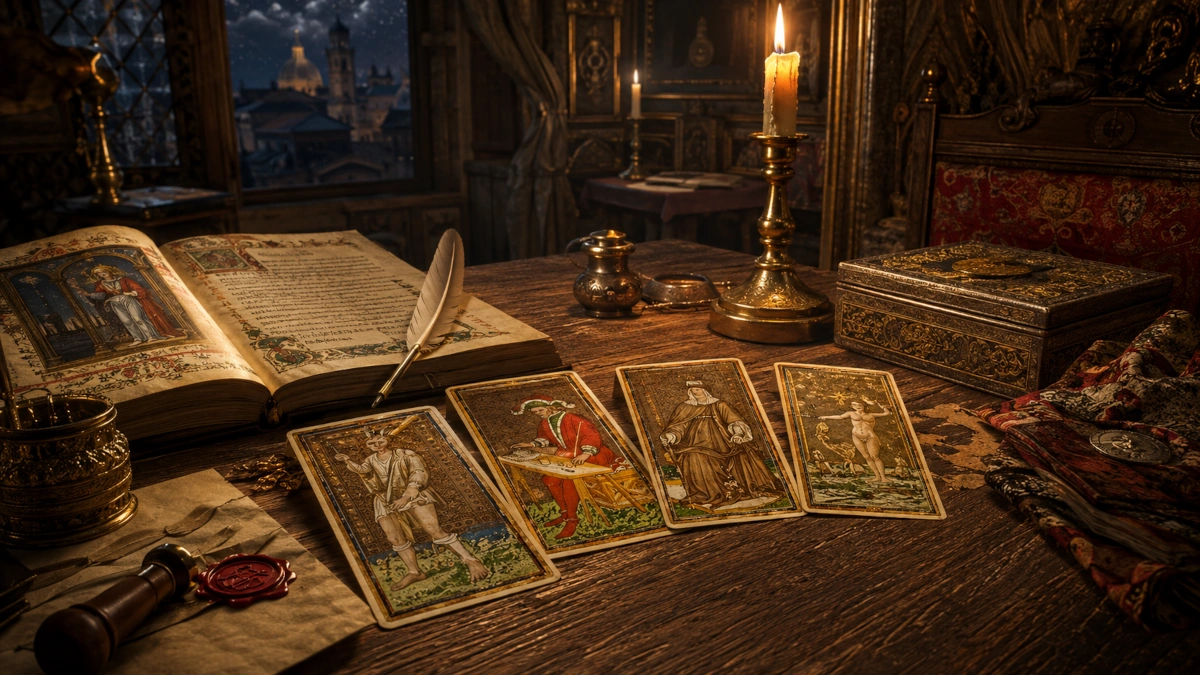
Among the most important surviving examples are the elaborately decorated cards associated with the Visconti and Sforza ruling families of Milan.
Most were created around the middle of the fifteenth century. They were carefully painted, sometimes with richly gilded backgrounds.
Their imagery depicts rulers, religious figures, virtues, and allegorical scenes. Many of these motifs remain familiar today, although their appearance and interpretation have changed over time.
These early cards were not created for modern spiritual consultations. They belonged to the courtly gaming culture of a society shaped by Christian imagery, political hierarchies, and allegorical representation.
The fact that we can recognize psychological or spiritual meanings in some of their images today does not mean that those interpretations were intended when the cards were first created.
This distinction is essential to understanding the history of Tarot.
2. From Courtly Luxury to a Popular Card Game
As printing technology spread and production methods improved, playing cards became accessible to broader sections of society.
Expensive, individually crafted decks gradually gave way to printed cards, which developed distinctive regional styles.
One particularly influential visual tradition would later become known as the Tarot de Marseille.
Its cards feature figures and motifs that continue to shape the appearance of many Tarot decks: the Magician, the Popess, the Emperor, the Hanged Man, Death, and the World.
Tarot, however, did not follow an identical structure everywhere. Regional variations differed in the number of cards, their sequence, and the design of individual images.
The familiar standard structure today consists of 78 cards: 22 trump cards, including the Fool, and 56 suit cards.
This arrangement emerged through a longer historical development. It should not be projected backward as an unchanged system supposedly inherited from antiquity.
For several centuries, Tarot remained primarily a card game.
The idea that its images had originally been created as a coded secret doctrine arose much later.
3. The Eighteenth Century: The Invention of a Hidden Past
Tarot underwent a decisive transformation in late eighteenth-century France.
In 1781, the scholar Antoine Court de Gébelin published an interpretation of the Tarot cards in the eighth volume of his work Le Monde primitif. His ideas would profoundly influence the subsequent history of Tarot.
Court de Gébelin believed that the images preserved remnants of ancient Egyptian wisdom.
He associated Tarot with the idea of a secret book containing knowledge passed down from Egyptian priests.
There is no reliable historical evidence supporting this theory of Egyptian origins. The surviving documentary evidence instead points to fifteenth-century Italy.
Nevertheless, Court de Gébelin’s interpretation proved extraordinarily influential.
It changed the very questions people asked about the cards.
Previously, Tarot had been understood primarily as part of a gaming tradition. Now its images were increasingly regarded as possible carriers of hidden teachings.
The historical origins of the cards gave way to a narrative about their supposedly secret beginnings.
That narrative would influence Western esotericism for generations.
Etteilla and the Emergence of Esoteric Tarot
Another key figure was Jean-Baptiste Alliette, better known as Etteilla.
As early as 1770, he published a work on divination using ordinary playing cards. Over the following decades, he developed his methods further and turned his attention to Tarot.
While Court de Gébelin primarily proposed a supposedly hidden history of the cards, Etteilla worked toward a practical system of interpretation.
During the late 1780s, he was involved in the development of a Tarot deck specifically designed for divination, commonly associated with the name Grand Etteilla.
Etteilla altered the sequence and meanings of numerous cards and incorporated astrological and other esoteric correspondences.
This marked a fundamental shift: the cards were no longer used exclusively for games but were deliberately adapted to interpret personal questions.
Important foundations of modern esoteric Tarot practice were established during this period.
4. The Nineteenth Century: Tarot Becomes a Universal Symbolic Language
During the nineteenth century, Tarot increasingly became part of Western occult and esoteric teachings.
One particularly influential figure was Éliphas Lévi.
He connected the Tarot cards with Kabbalah, the Hebrew alphabet, and ideas about a universal system of magical symbolism.
Within this interpretation, the cards became elements of a comprehensive symbolic framework intended to unite different religious, philosophical, and esoteric traditions.
Papus, whose birth name was Gérard Encausse, also adopted and developed such ideas in his 1889 work Le Tarot des Bohémiens.
These authors were not neutral historians of Tarot. They interpreted the cards through the lens of their own esoteric convictions.
Their writings are therefore especially important as historical evidence of the development of Western esotericism.
The Hermetic Order of the Golden Dawn
With the founding of the Hermetic Order of the Golden Dawn in 1888, the systematic integration of Tarot with other occult traditions gained further importance.
The order developed elaborate correspondences between Tarot cards, astrology, Kabbalah, and ceremonial magic.
These relationships were taught within the organization and influenced numerous later Tarot decks.
A system of interpretation emerged that extended far beyond the cards‘ original function.
The images were now understood as elements within a symbolic order in which individual cards were associated with cosmological and spiritual concepts.
From a historical perspective, this represented a further development of Tarot, not the rediscovery of its demonstrable original meaning.
5. The Rider-Waite-Smith Tarot: When the Images Began to Tell Stories
The year 1909 marks one of the most consequential developments in the history of modern Tarot.
That year saw the publication of the deck now known as the Rider-Waite-Smith Tarot.
It was created through a collaboration between Arthur Edward Waite and the artist Pamela Colman Smith, and published by William Rider & Son.
Waite developed the deck’s esoteric framework, while Smith created its visual imagery.
Her artistic contribution was particularly significant.
Unlike many older Tarot decks, the numbered cards of the four suits were no longer represented merely by the corresponding number of objects.
Instead, they were given individual illustrated scenes.
People face decisions, carry burdens, celebrate together, or experience loss. These images can be related directly to recognizable human experiences.
The Three of Swords depicts a heart pierced by swords. The Eight of Cups shows a figure walking away from a row of cups. The Ten of Wands portrays someone carrying a heavy burden.
Such scenes make it easier to engage with the cards intuitively and through storytelling.
The Rider-Waite-Smith Tarot consequently became one of the most important foundations of modern Tarot interpretation.
Numerous later decks have adopted its visual language, modified it, or deliberately departed from it.
6. The Thoth Tarot: Between Magic, Art, and Philosophical Construction
While the Rider-Waite-Smith Tarot derives much of its impact from recognizable narrative scenes, the Thoth Tarot takes a different approach.
It emerged from the collaboration between Aleister Crowley and the artist Lady Frieda Harris.
Between 1938 and 1943, Harris created the paintings for the deck. Crowley supplied much of its conceptual and esoteric foundation.
The cards combine astrological, Kabbalistic, and alchemical symbolism with a modern, sometimes abstract visual language.
In 1944, Crowley published The Book of Thoth, explaining the system underlying the cards.
The complete deck, however, was not published until 1969, long after both collaborators had died.
The Thoth Tarot illustrates how differently Tarot could develop during the twentieth century.
Where Smith’s images frequently depict familiar human situations, Harris created a complex symbolic world whose interpretation often requires additional knowledge.
Both decks rank among the most influential artistic and esoteric interpretations of modern Tarot.
7. The Twentieth Century: Tarot Encounters Psychology
During the twentieth century, Tarot increasingly came to be explored outside traditional occult schools.
The reception of Carl Gustav Jung’s analytical psychology played an important role in this development.
Jung devoted considerable attention to symbols, myths, dreams, and archetypal motifs. His theories of the collective unconscious and recurring symbolic structures later provided inspiration for authors seeking new ways to interpret Tarot.
An important historical distinction must be made here.
Jung himself did not develop a comprehensive system of psychological Tarot interpretation. Rather, later authors applied his theories to the cards.
One well-known example is Sallie Nichols’s book Jung and Tarot: An Archetypal Journey, published in 1980.
Nichols approached the Major Arcana as a sequence of archetypal images that could be associated with fundamental experiences of human development.
This contributed to the growing importance of an approach in which Tarot was no longer understood primarily as a means of predicting external events.
Instead, the cards became a stimulus for self-reflection, the exploration of inner conflicts, and the examination of personal development.
This does not, however, mean that Tarot’s psychological effectiveness as an independent method has been scientifically established.
Engaging with the cards symbolically may encourage reflection. Whether, and to what extent, this produces reliable personal insights depends on many factors.
8. The Digital Age: Tarot Becomes Accessible Worldwide
The internet also transformed the way Tarot spread and developed.
What once required access to particular books, teachers, or card decks is now more easily available through digital services, videos, and online communities.
Platforms such as YouTube, Instagram, and TikTok have created new ways of introducing people to Tarot.
At the same time, the variety of available decks has expanded considerably.
Contemporary artists reinterpret traditional motifs, introduce different cultural references, or develop entirely new visual worlds.
Today, Tarot appears in feminist, mythological, psychological, literary, and many other forms.
Its practical use has changed as well.
Alongside personal consultations, there are digital readings, automated card draws, and software applications that generate interpretations from predefined meanings.
These developments make Tarot more accessible, but they also raise questions.
What distinguishes an automatically generated card interpretation from a personal consultation? What role do experience, conversation, and individual circumstances play? And how can we prevent general statements from being mistaken for precise insights into someone’s life?
Such questions are as much a part of Tarot’s contemporary development as new decks and digital platforms.
9. Three Histories of Tarot — and Why We Should Distinguish Them
Looking back over the centuries, we can identify three interconnected developments.
The first is the history of the cards themselves.
It begins with European playing cards and the trump-card games of Renaissance Italy. This history concerns documentary evidence, surviving decks, printing techniques, and cultural contexts.
The second is the history of their esoteric interpretations.
It leads from Court de Gébelin’s theory of Egyptian origins through Etteilla, Éliphas Lévi, and the Golden Dawn to the complex symbolic systems of the twentieth century.
These interpretations are historically significant, even though their claims about Tarot’s supposedly ancient origins remain unsupported.
The third is the history of the personal meanings people attribute to the cards.
It includes spiritual experiences, psychological interpretations, and the contemporary use of Tarot as a starting point for reflection.
These three histories overlap, but they should not be confused.
A symbol can hold profound personal meaning without its supposed ancient origins being historically accurate.
Likewise, an esoteric tradition may exert considerable cultural influence without its metaphysical claims having been scientifically verified.
Maintaining these distinctions allows us to approach Tarot with both historical accuracy and openness toward its symbolic significance.
10. What the History of Tarot Reveals About Understanding
Perhaps the most fascinating aspect of Tarot’s history is not the search for a hidden origin, but the continuous transformation of its meaning.
The same cards once used for games at Italian princely courts could, centuries later, be regarded as evidence of Egyptian wisdom.
Later, they were connected with astrological and Kabbalistic systems, artistically reimagined, and eventually interpreted as representations of human experience.
The basic structure of the cards remained recognizable over long periods. Yet the questions people asked of them changed.
This reveals a remarkable characteristic of symbolic systems.
Their significance does not reside exclusively in their original creation. It also emerges from the cultural contexts in which they are interpreted and from the people who engage with them.
That does not mean every interpretation is equally convincing.
Historical claims must be examined against documentary evidence. Psychological explanations require reasoned arguments. Spiritual interpretations should remain recognizable as such.
Within these boundaries, however, symbols can inspire new questions.
The history of Tarot does not demonstrate that its images have preserved unchanging truths for thousands of years. It reveals how people, across centuries, have continually discovered new possibilities for understanding within the same images.
From Historical Card Game to Personal Tarot Reading
Today, we encounter Tarot in a form shaped by numerous historical developments.
The imagery of the Renaissance, the esoteric interpretations of the eighteenth and nineteenth centuries, and the artistic and psychological approaches of the modern era all contribute to its character.
When we look at a Tarot card, therefore, we encounter more than a single symbol. We encounter a multilayered cultural tradition.
In my own work, I am particularly interested in what happens when these inherited images meet a specific personal question.
What thoughts emerge? Which connections appear meaningful? And how can intuitive impressions be distinguished from verifiable information?
A personal Tarot reading can create a space in which such questions are explored without treating the cards as infallible authorities.
If you would like to explore Tarot’s symbolism not only from a historical perspective but also in relation to a question from your own life, we can examine it together.
ALARIK TAROT
TAROT & SYMBOLIC INSIGHT
Beyond the Visible. Into the Meaning.
Personal Tarot & Lenormand Readings, Astrology and Mystical Exploration
Request a Personal Reading
Legal Information
Tarot and astrology readings offer symbolic interpretation and personal reflection. They are not a substitute for professional medical, psychological, legal or financial advice.
© 2026 Alarik Tarot · All rights reserved.