
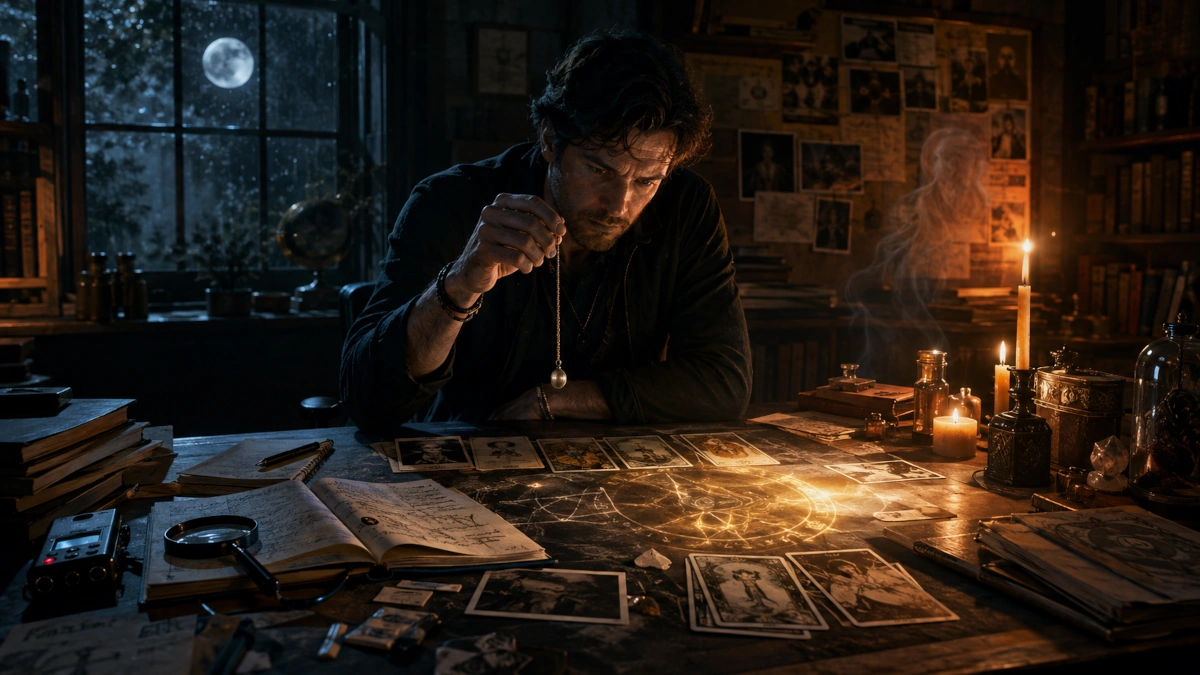
Spiritual Investigations Between Skepticism and Evidence: What Can We Really Know?
On occult investigations, unusual experiences, critical examination, and our responsibility toward the unknown.
A sound in an abandoned building. A figure appearing for a fleeting moment at the edge of one’s vision. An object found somewhere else, although nobody recalls moving it.
Experiences like these can be unsettling, fascinating, or raise questions for which no simple answer immediately presents itself.
Some people speak of coincidences, perceptual illusions, or external influences that have not yet been identified. Others suspect a spiritual or paranormal cause.
Between these explanations lies a vast field of observations, memories, expectations, and interpretations.
This is where the challenge of spiritual investigations begins.
Anyone examining unusual phenomena must resist two temptations: prematurely declaring that the supernatural has already been proven, and being equally quick to assume that every unusual experience is meaningless without further examination.
A serious investigation does not begin with an answer. It begins by asking what actually happened.
1. What Are Spiritual or Occult Investigations?
The term spiritual investigations encompasses different approaches to examining unusual experiences, phenomena perceived as paranormal, or events interpreted in spiritual terms.
These may include reports of apparent ghostly apparitions, seemingly unexplained sounds, unusual perceptions, or experiences that those involved associate with deceased individuals.
The term does not, however, describe a single, standardized scientific method.
Different traditions and individual approaches employ different techniques.
Some investigators use cameras, audio recordings, or technical measuring instruments. Others work with interviews, historical research, Tarot cards, pendulums, or intuitive impressions.
These methods differ considerably in their underlying assumptions and in the conclusions they can support.
A camera, for example, can document a visible event. A thermometer measures certain physical conditions. A Tarot spread, by contrast, produces a symbolic arrangement of cards that is then interpreted.
The results of these approaches cannot simply be treated as equivalent.
A spiritual investigation may offer different perspectives on a case. This does not mean that every method used is equally capable of establishing facts.
2. The Criticism That Spiritual Investigations Are Unscientific
One of the most frequent criticisms concerns the lack of scientific confirmation for paranormal explanations.
This objection is justified whenever spiritual investigators claim that their methods can reliably demonstrate the existence of ghosts, communication with the dead, or other supernatural causes.
To date, there is no generally accepted, reproducible scientific evidence supporting such abilities.
This does not, however, mean that unusual experiences cannot be investigated.
A recurring sound can be documented. Changes in room temperature can be measured. Witness statements can be placed in chronological order and compared.
What matters is which conclusions are drawn from these observations.
What Technical Instruments Actually Measure
Popular ghost-hunting practices frequently involve electromagnetic field meters, thermal imaging cameras, digital audio recorders, and so-called ghost boxes.
Such devices can produce striking results.
Yet their technical functions also define the limits of what they can tell us.
An EMF meter detects electromagnetic fields or certain changes in those fields. It cannot establish whether a ghost is present.
A thermal imaging camera detects infrared radiation and uses it to display temperature differences or apparent surface temperatures. Unusual images may result from reflections, material properties, or environmental conditions.
An audio recorder can document sounds. Whether an indistinct recording actually contains a voice requires separate examination.
Ghost boxes generate or receive audio material that is subsequently interpreted. Their use as supposed communication devices for contacting the dead has not been scientifically validated.
A measurement is, first and foremost, a measurement. Connecting it to a particular cause requires additional evidence and reasoning.
It is precisely this intermediate step that is often overlooked in popular paranormal accounts.
3. Why Unusual Perceptions Can Be So Convincing
Not every experience can be clearly understood at the moment it occurs.
Our perceptual system constantly processes incomplete information.
We recognize shapes in shadows, hear familiar patterns in indistinct sounds, and fill in missing details based on experience and expectation.
These abilities are indispensable in everyday life.
Yet they can also lead us to recognize something in ambiguous impressions that is not objectively present.
A familiar example is pareidolia.
This occurs when we perceive recognizable patterns in random structures, such as faces in clouds or apparent voices in indistinct sounds.
Memories, too, are not unchanging recordings.
They can be altered by later information, conversations, and repeated retelling.
This does not mean that people who report unusual experiences are inherently unreliable.
It means that we must distinguish between the subjective experience and its possible cause.
Someone may report with complete sincerity that they saw a figure, without this establishing what actually produced that perception.
The Importance of Respectful Questioning
An investigation should therefore begin with open-ended questions whenever possible.
What was perceived? When did it happen? What were the lighting conditions? Who was present? Was the event documented immediately, or was it recalled only later?
Leading questions can influence subsequent accounts.
For example, asking someone whether they “felt the presence of a ghost” already introduces a particular explanation.
A more open question would be: “What exactly did you perceive at that moment?”
This distinction may seem minor.
For the quality of an investigation, it is essential.
4. Observation, Interpretation, and Claim: Three Different Levels
The most important methodological boundary does not lie between technology and spirituality.
It lies between three distinct levels.
Observation
An observation describes as precisely as possible what was perceived or documented.
Example: At 11:14 p.m., a repeated knocking sound was recorded in an unoccupied room.
Interpretation
An interpretation attempts to assign meaning or a possible cause to the event.
Example: The sound might have originated from heating pipes, structural stresses, external disturbances, or another source that has not yet been identified.
Claim
A claim asserts a particular explanation.
Example: The knocking was caused by a deceased former resident.
While the observation can be documented, the specific claim about its cause requires additional evidence.
A spiritual explanation may be considered as a personal or traditional interpretation.
It must not, however, be treated as fact simply because an ordinary explanation has not yet been found.
The absence of an explanation is not evidence of a supernatural cause.
This principle protects an investigation against premature conclusions.
5. What Role Can Tarot and Other Oracles Play?
Tarot, Lenormand, pendulums, and other oracle systems have long been part of various spiritual practices.
Within an occult investigation, they may be used to explore a case through symbolic questions.
However, they produce a different kind of material from technical measurements or historical sources.
A Tarot card may, for example, introduce themes such as loss, attachment, conflict, or change.
These themes can be considered in relation to the accounts and experiences surrounding a case.
Yet such a correspondence does not prove that the card has revealed an unknown fact.
It becomes particularly problematic when symbolic interpretations lead to specific accusations.
Within certain Tarot traditions, the Seven of Swords may be associated with secrecy or deception.
But this does not justify concluding that a particular person has lied, stolen something, or committed a crime.
Similarly, the movement of a pendulum is not reliable evidence of an external spiritual cause. Unconscious muscle movements, known as ideomotor effects, can influence its motion.
Symbolic Exploration Rather Than Proof of Facts
A responsible use of spiritual methods therefore requires a clear distinction.
A card reading may inspire questions, reveal alternative interpretations, or encourage reflection on how someone personally relates to an event.
It should not replace historical documents, witness statements, or verifiable observations.
If a symbolic interpretation gives rise to a specific, testable hypothesis, that hypothesis must be investigated independently of the interpretation.
Only then is it possible to assess whether genuinely new information has been obtained.
6. How a Structured Spiritual Investigation Can Proceed
Although spiritual practices are not scientifically validated methods of demonstrating paranormal causes, the investigation of an unusual experience can still be carefully structured.
One possible approach consists of five phases.
Phase 1: The Original Account
The first step is to record what the person involved experienced.
The time, location, people present, and exact sequence of events are important.
It should also be documented which explanations have already been suggested and what information is available independently of those assumptions.
The aim is to preserve the original account as faithfully as possible.
Phase 2: Examining Ordinary Causes
The next step is to consider plausible everyday explanations.
In the case of unusual sounds, possible causes include technical installations, structural movement, animals, or external disturbances.
Unusual light and shadow effects may involve lighting conditions, reflections, or viewing angles.
Environmental conditions should also be considered when perceptions recur.
If there are indications of an immediate hazard, such as faulty electrical installations, structural damage, or possible exposure to harmful substances, assessment by qualified professionals must take priority.
Phase 3: Documentation and Comparison
Recurring events can be recorded together with their dates, times, and environmental conditions.
Where technical recordings are made, the original files should be preserved without alteration whenever possible.
It is also useful to distinguish between immediate observations and memories recalled later.
If several witnesses are involved, interviewing them separately may help reduce mutual influence.
Phase 4: Symbolic Investigation
Only at an additional, clearly identified level should Tarot, Lenormand, or other spiritual practices be introduced.
The question should be established before the cards are drawn.
The cards and their original interpretation should be documented.
If testable hypotheses emerge, they must not subsequently be adjusted to fit information that was already known.
A symbolic interpretation remains an interpretation unless it is independently confirmed.
Phase 5: Evaluation and Findings
Finally, the available information is brought together.
A clear distinction should be made between established observations, plausible explanations, unresolved questions, and spiritual interpretations.
Not every investigation leads to a definitive result.
Sometimes an ordinary cause can be identified.
Sometimes several explanations remain possible.
And sometimes the available information is insufficient to support a reliable conclusion.
Such an outcome can still be valuable.
7. When a Case Remains Unresolved
The word unexplained is often used as though it already describes a special property of an event.
In reality, it initially describes a limit of our present knowledge.
A sound may remain unexplained because no adequate recording exists.
An apparition may no longer be verifiable because it was observed only once.
A historical account may be contradictory because essential sources are missing.
In such circumstances, it would be premature to assume a paranormal cause.
Nor is it necessary to invent an explanation simply to bring an investigation to a conclusion.
The willingness to tolerate uncertainty is part of every careful examination of unusual experiences.
The unknown does not become more meaningful merely because we rush to give it a name.
Sometimes the most appropriate conclusion is simply that we do not know enough.
8. Ethical Boundaries: When People and Personal Lives Are Involved
Spiritual investigations can extend far beyond unusual noises or apparent apparitions.
Sometimes they involve family conflicts, deaths, missing persons, or unresolved events.
In these circumstances, the need for restraint and responsibility becomes considerably greater.
A symbolic interpretation must never be presented as proof of a particular person’s guilt.
Nor should anyone claim that a missing person is in a particular location solely because a card reading has been interpreted that way.
Such statements can distress relatives, create unfounded hopes, or interfere with genuine investigations.
Where there is concrete evidence of a crime or danger, the appropriate authorities or qualified professionals should be contacted.
Protecting personal information is equally important.
Reports, recordings, and documents must not be published or shared with third parties without proper authorization.
A Particular Responsibility Toward People Experiencing Distress
Someone who has experienced an unusual event may be seeking not only an explanation but also reassurance.
An investigation should therefore avoid intensifying their fears.
Claims about curses, dangerous spirits, or unavoidable supernatural threats can cause considerable harm.
If an experience is associated with severe anxiety, sleep difficulties, or other persistent distress, professional medical or psychological support may be appropriate.
Spiritual guidance must not replace such support.
9. Commercialization: When Does Helping Become a Problematic Business?
Whether spiritual investigations may be offered as paid services cannot be determined simply by the presence of a fee.
Research, documentation, consultation, and the evaluation of extensive records can all require considerable time and effort.
What matters is the service actually being offered.
Problems arise when investigators present a paranormal cause as certain before an investigation has even begun, or promise to eliminate a supernatural problem reliably in exchange for payment.
Business models that first create fear and then offer a paid solution are particularly concerning.
For example, someone might claim that a person is being pursued by a dangerous spirit and urgently needs several expensive rituals.
A responsible service should clearly disclose its methods, limitations, and costs.
How I Handle Enquiries
At Alarik, a potential occult investigation begins with a no-obligation enquiry.
The first step is to consider the nature of the reported case and whether further examination would be appropriate at all.
Only then can a decision be made about whether an individual investigation can be offered.
Any applicable fee is communicated before a commission is agreed upon.
Neither a paranormal cause nor the successful resolution of an unusual event is guaranteed.
The service consists of the agreed investigation and a transparent evaluation of its findings, not a promise of any particular discovery.
10. Ghost Hunting as Entertainment — and Its Limits
Paranormal phenomena have a powerful narrative appeal.
Dark rooms, abandoned buildings, and unexpected sounds create suspense.
Film and television have long made use of this effect.
Many modern ghost-hunting programmes also rely on dramatic music, rapid editing, and the expectation that every unusual perception might conceal an unseen presence.
As entertainment, such programmes can be fascinating.
They become problematic, however, when dramatization and documentation can no longer be distinguished.
A sudden sound may appear more threatening through editing than it did in the original situation.
An indistinct audio recording may seem to contain a clearly understandable voice when words are displayed on screen.
And the selective presentation of scenes may create the impression that several events were directly connected.
This does not mean that every filmed portrayal of paranormal investigations is dishonest.
It means that storytelling techniques must be distinguished from the requirements of verifiable documentation.
A careful investigation does not have to be spectacular.
Sometimes a sober description reveals far more than a dramatic recording.
11. Skepticism Is Not the Opposite of Curiosity
Skepticism is sometimes understood as the outright rejection of unusual experiences.
But a critical approach does not require us to decide which explanation is correct before an investigation has even begun.
Instead, it requires us to evaluate claims according to the evidence supporting them.
Someone reporting a ghostly apparition can be taken seriously without automatically accepting their interpretation.
Someone documenting an unusual event may contribute to further investigation even if an ordinary cause is eventually discovered.
And someone using spiritual symbolic systems can acknowledge their cultural and personal significance without attributing scientifically unproven evidential powers to them.
This approach allows for an openness grounded neither in sensationalism nor in premature certainty.
Not every unusual experience is paranormal. But every carefully described experience can provide a reason to look more closely.
12. My Approach: Encountering the Unknown Without Claiming Ownership of It
What interests me about unusual phenomena is not merely the possibility of an extraordinary explanation.
It is the encounter with situations in which our familiar patterns of interpretation do not immediately provide an answer.
Someone experiences something they cannot explain.
A historical account contains contradictory information.
An apparently ordinary occurrence is called into question by an unusual observation.
Such situations awaken curiosity.
But curiosity alone is not knowledge.
That is why I distinguish between documented information, symbolic interpretations, and personal impressions in my work.
Tarot and Lenormand can open up additional questions. Historical research can reveal connections. Technical recordings can preserve observations.
None of these approaches should be expected to prove more than its particular method can actually establish.
A spiritual investigation must also allow for the possibility that no paranormal connection can be demonstrated.
The unknown does not lose its fascination because of this.
On the contrary, only when we are willing to question our own expectations can we recognize which questions genuinely remain unanswered.
The mystery does not begin when we claim a supernatural explanation. It begins when we are willing to look more closely without already knowing the outcome.
13. What Spiritual Investigations Can — and Cannot — Achieve
A responsible spiritual investigation can help structure unusual experiences, document observations, and examine different possible explanations.
It can incorporate historical information and use symbolic interpretations as an additional perspective.
It may also help distinguish between the original experience and the ideas that subsequently developed around it.
Its limitations, however, remain essential.
Spiritual methods cannot reliably demonstrate the existence of ghosts, nor can they replace criminal, medical, or psychological investigations.
Likewise, an occult investigation cannot guarantee that a mysterious event will be explained.
Its potential value lies in the careful examination of an unusual experience, transparent documentation, and the willingness to consider different explanations.
Sometimes this leads to a plausible answer.
Sometimes to a new question.
And sometimes a mystery remains.
That possibility, too, is part of the investigation.
When an Unusual Experience Deserves a Closer Look
Perhaps you have experienced something that you have not yet been able to explain.
Perhaps unusual sounds or perceptions keep recurring. Perhaps a historical account or a personal experience continues to occupy your thoughts, and you would like to understand its significance more clearly.
Not every unusual experience requires an extensive investigation.
But when observations recur, specific questions remain unanswered, or different pieces of information need to be examined together, a structured approach may be worthwhile.
The starting point is not the assertion of a paranormal cause.
The starting point is your case.
What was observed? What information is available? Which explanations have already been examined? And which questions are worth pursuing further?
If you would like to enquire about an investigation, you can begin by telling me about your situation.
Alarik — Following the Traces of the Unexplained.
ALARIK TAROT
TAROT & SYMBOLIC INSIGHT
Beyond the Visible. Into the Meaning.
Personal Tarot & Lenormand Readings, Astrology and Mystical Exploration
Request a Personal Reading
Legal Information
Tarot and astrology readings offer symbolic interpretation and personal reflection. They are not a substitute for professional medical, psychological, legal or financial advice.
© 2026 Alarik Tarot · All rights reserved.